This is in Frank Arsenault form— the third camp different than I've seen it elsewhere. We get to play the third camp twice, without the extra repetition of the second camp afterwards.
Friday, September 27, 2024
Three Camps in first inversion paradiddles - UPDATED
This is in Frank Arsenault form— the third camp different than I've seen it elsewhere. We get to play the third camp twice, without the extra repetition of the second camp afterwards.
Saturday, May 06, 2023
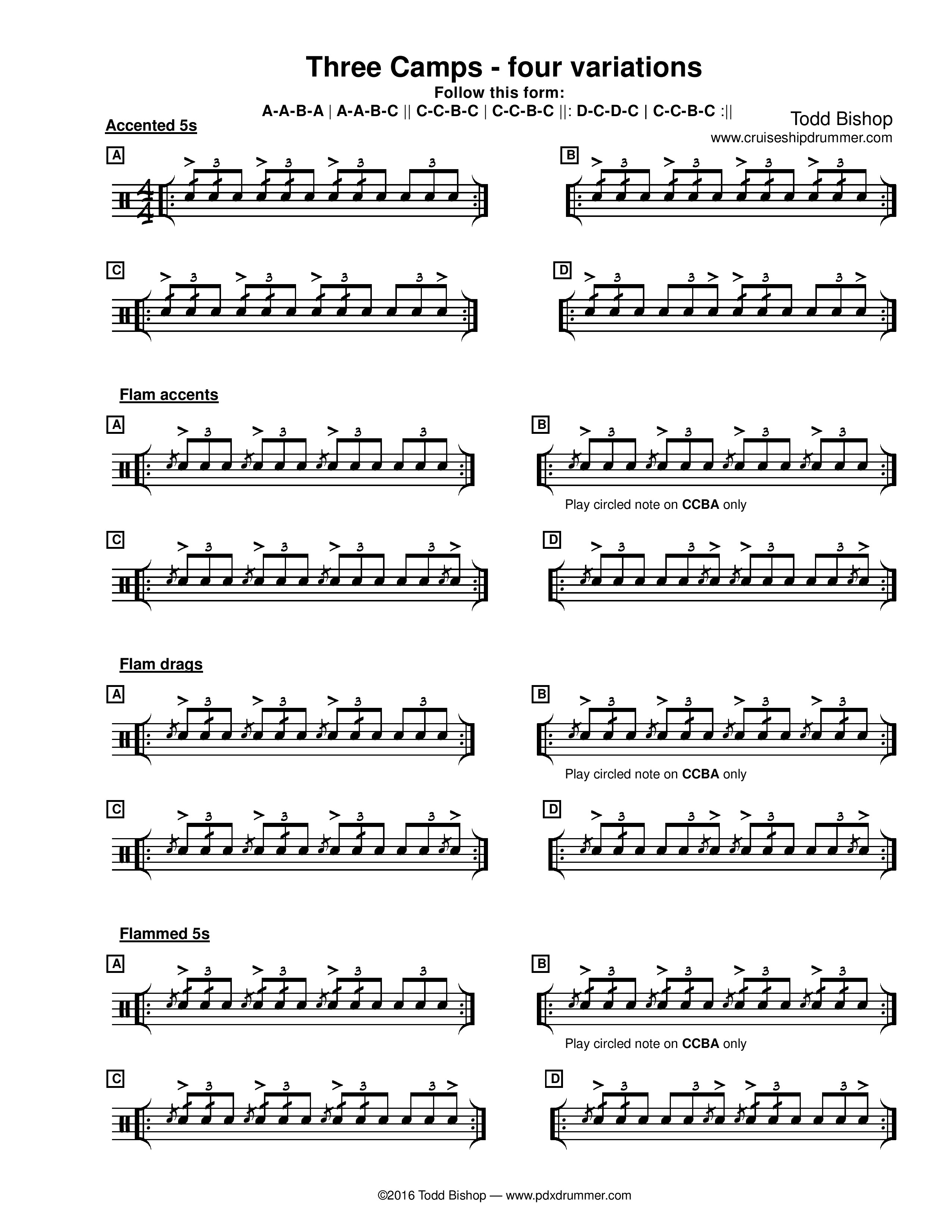
Three camps: four variations
Four alternative ways of playing the rudimental piece Three Camps, that I'm practicing this week, accented 5 stroke rolls, flam accents, flam drags, and flammed 5s.
Learn each measure individually, then play them in the form given at the top of the page. Chop out.
Sunday, October 16, 2022
Three Camps in 3 - jazz waltz -02
Another set of Three Camps-form exercises in 3/4, for the drum set. The first two have alternating triplets between the snare and bass, the last two are based on a dotted quarter rhythm, with an extra note in there.
Still digging this format— it makes you practice one thing for as long as you're supposed to, with minor variations. Good alternative to practicing out of Reed and having to deal with a lot of reading.
Check out the forms carefully— the circled bass drum notes are added or swapped for the snare drum on some of them. Learn each two measure phrase, then put them in the form to make the complete exercise.
Saturday, October 08, 2022
Three Camps in 3 - jazz waltz - 01
Continuing the thing from the other day, here are some drum set variations on Three Camps, in 3/4 time, in a jazz waltz feel. I practice this same type of thing using my book Syncopation in 3, which you should own, but it's nice to have a clean, structured shot at some simple variations on one idea. And the Three Camps format makes you practice it for about as long as you should practice it.
Practice each measure by itself, then put them together in the form given at the top of the page. Add hihat on beat 2, or beats 2 and 3, pencil it in on the a partial on 1, and on beat 3, Elvin-style. Anything. Scratch out that middle bass drum note on the D part of the dotted quarter version if you want— it doesn't fit the pattern, exactly.
Practice it with my loop of All Blues.
Thursday, October 06, 2022
Three Camps in 3
Something about doing it in 3 encourages you do it faster— I like Three Camps for working on fast singles. And the piece is 50% longer, so it will help your endurance.
Sunday, June 13, 2021
Three Camps for drumset - jazz / uptempo - 01
I wrote this to isolate some things used in my main uptempo Reed method— which I continue to find an excellent method. This is good if you need to polish a few of those bass drum patterns in a more focused way.
I've simplified the structure somewhat— the third camp just repeats the last two measures of the second camp, backwards. The piece really needed that tiny bit of variety, and I find this a little dull to practice. I'll probably skip the whole last section altogether. Still, it's better than just practicing a one measure pattern over and over again, right?
Sunday, May 02, 2021
Three Camps for drum set: 16th notes - SSBB
More of Three Camps adapted for drum set, with a 16th note SSBB pattern, in a jazz feel. Let's call this an advanced page, because there's a little extra 16th note filler on the snare drum that many won't have worked out, and there are a few notes you have to follow. It's not easy to just read it. Follow the instructions, learn them, memorize them, throw the page away.
We're getting fairly remote from the original piece, but who cares, the exercises are good. With this particular version the normal thing on the 'D' measures— the beginning of the third camp— didn't work so well, so I deviated from the logic of the original a little bit.
Note that on “Basic, starting on 2” you have to continue the SSBB pattern on beat 1 of the last measure of the AABA and CCBC sections. On both of the “syncopated” versions, there are circled notes that you play only on the A* and C* measures, as indicated in the form written beneath each variation.
To reduce visual clutter I haven't indicated a hihat part. Play it on beats 2 and 4, or play it on all of the &s for a double time feel.
Thursday, December 24, 2020
Three Camps for drum set - inverted quarter note triplet fill - 07
I'm telling you this is a good system. It gives you the thing, some basic variations on it, starting on 1 or 2, straight and syncopated, and it makes you do it for as long as you should do it. Basically that's what you should do with every single identifiable idea you play on the drum set.
This is the inverse of what I posted last week— we're playing a jazz time feel, with the bass drum playing the major TC accents, filling in the remaining notes of an inverted quarter note triplet on the snare drum. And there is an accompanying Reed-type method to develop all of this further.
It's fun doing the standard left hand moves with these pages, playing a rim click on the snare drum— gives a nice Elvin-like texture.
Thursday, December 17, 2020
Three Camps for drum set - quarter note triplet fill - 06
I started doing these because I wanted a composed drill, like Alan Dawson's Rudimental Ritual, that I would actually play. It has worked out really well. This entry is the same as the first one, except the snare drum fills the remainder of the the quarter note triplet— whatever isn't covered by the bass drum. It's similar to the new Reed method I outlined last month.
Learn them, paying attention to the different form for each version, memorize them, find a practice loop you like, and drill them.
Monday, November 30, 2020
Three Camps for drumset: Funk shuffle - 01
Another page of Three Camps interpretations for drumset, based on a 4/4 funk shuffle groove, with a normal jazz rhythm on the cymbal. These focus on pretty normal vocabulary for that type of thing. I wrote it to go with a practice loop of Ummh by Bobby Hutcherson, with Mickey Roker playing a nice deep shuffle groove.
The foundation groove is the B portion of each drill— practice that by itself, if you need to, before playing the drills. Unlike the other TCFDS pages, these all use the normal form of the piece— there are no starting-on-2 or syncopated versions.
Here's that track— I'll post my loop soon:
Wednesday, November 11, 2020
Three Camps for drum set - inverted - 05
Another page working on normal jazz drumset vocabulary using Three Camps— we're sort of inverting the basic version, except I've taken a few liberties with it to make a normal Elvin-like texture out of it.
I really like this whole method, and I think it is really worth your while to learn it, figuring out all the correct form for each version. It's easy when you do it. It's really good for people who like clearly-defined lesson assignments, or for undisciplined people like me who tend to drift into creative practice rather than practice things thoroughly.
Tuesday, October 20, 2020
Three Camps for drumset - 16th notes / basic - 04
This is the basic form of Three Camps for drumset, converted into 16th notes. I continue to dig this format for practicing jazz coordination. For me the main attraction of this page is the Elvin-like thing we see at the end of measure C of the first version, and throughout the page. We really get to polish that sucker.
Check the form carefully for each version— each version has the measures in a different order. It's not as difficult/weird as it seems.
You can play these substituting the left foot for the bass drum— in that case ignore the written hihat part. Doing it that way, at faster tempos I might eliminate the second note of any double— on the a-1 or a-3 in measure D of the first version, for example. Play the hihat on the a, don't play it on the 1.
You could also mix things up by playing the 1e-a rhythm (on whatever beats it occurs) as a triplet, as in the original triplet version of this page, and play the full beats of 16ths as 16ths. That's a thing Elvin Jones does a lot.
Monday, September 21, 2020
Three Camps for drumset - RLL/RRL/six stroke - 03
Settle in, kids, we're going to be seeing several more of these, because a) I like it and I think it's an effective format, b) I can't think of much else to do right now. Times are weird.
This one uses all the basic things found in Alan Dawson's “Ruff Bossa” method— that's a triplet system using all the parts of the six stroke roll, with RLLs, RRLs, RLLRRLs, plus occasional alternating swing 8ths.
Memorize all four of these and practice them as a complete unit. Alert on the first syncopated version: on the “first camp” (AABA), play the B measure as a full measure of RRL. The swing 8th on the first beat only happens on CCBA parts.
Notes on the updated page:
• The typo in the syncopated/starting on 2 variation was that beat 4 on the A measure should have been on beat 1.
• I changed the sticking on the A measures to include a six stroke roll sticking— RLLRRL. Or you can just play the main sticking for the whole measure— RLL on the first two versions, or RRL on the second two.
Get the pdf
Sunday, September 13, 2020
Three Camps for drum set - alternating triplets - 02
OK, I officially like this new system— adapting the format of the rudimental piece Three Camps for drumset. It does exactly what it's supposed to do: trick you into practicing some common things longer. The format is 32 bars long, and for every basic idea there is a regular version and an inverted version, so you're playing two standard choruses of each idea, with basic variations. That's a good amount of time to do one thing.
My biggest concern, that the altered form on the inverted versions would be too much of a pain for easy practicing, is not a problem. Actually my biggest concern was that the whole thing would be pointless, but it isn't. It makes sense, and I feel more together after having played through it.
In part 2 we'll use triplets alternating between the snare drum and bass drum. The first page is the version I use; the second page is a slightly simplified version that is a little closer to the original piece.
You can add the hihat on 2/4 when playing it with snare drum and bass drum, and then run it again substituting the hihat for the bass drum part. Find a practice loop at the tempo you want— or make one— and hit it. Here's a slow one, and a slow medium tempo, or a slightly brighter medium tempo.
Updates to the second page:
• Finale did something weird and the letters for each measure got screwed up.
• Made some changes so patterns would be consistent for each version.
• On the versions with the pattern starting on beat 2: on the AAAB and CCCB parts you have to make a small change on the last A or C. Read the note on the page and figure it out. It makes sense if you just play the piece.
Get the pdf
Sunday, September 06, 2020
Three Camps for drum set - 01
• Basic, with the bass drum playing the same accents as the original piece.
• Basic form with the accents displaced one beat, starting on beat 2.
• Syncopated, with the original accents moved to the &.
• Syncopated, accents on the & starting on beat 2.
3rd | 2nd | 2nd-coda
3rd | 2nd | 3rd | 2nd-coda
Tuesday, December 17, 2019
Three Camps - 16th notes, combination stickings
Practice each measure individually, then put them together to make the piece. I put them in the easiest order for learning them, not in the order they appear in the piece. Memorize the piece and it will be easy to put everything in its right place.
Get the pdf
Tuesday, April 09, 2019
Three Camps in 6-stroke rolls
Whatever: this is a companion for the recent Three Camps in paradiddle-diddles; taken together they're an opportunity to really smoke your major sixtuplet stickings. You should be able to do these fast.
Normally when playing this rudiment I accent both of the singles— the R at the beginning and the L at the end; doing that here messes with the integrity of the piece. Accent that trailing L lightly, if you must.
Get the pdf
Sunday, March 31, 2019
Three Camps in paradiddle-diddles
Here it is with sixtuplet paradiddle-diddles as the main thing. There are three things in it: 1. accented paradiddle-diddles, 2. unaccented paradiddle-diddles, 3. a single paradiddle ending in a left hand accent. And 4. an ending— I've adapted the traditional ending, rather than the long fp roll I usually do.
Play it many times as written, and with the stickings reversed, starting with the left hand. Don't be confused by the abbreviated notation I've used— those are just more accented paradiddle-diddles in a sixtuplet rhythm.
Get the pdf
Friday, September 21, 2018
Three Camps video roundup
This is played by Frank Arsenault, a leading rudimental player when Wm. F. Ludwig, Sanford Moeller, et al were initially pushing their “26 Essential Rudiments” idea they made up. Three Camps begins at 2:20 in this video:
It's very interesting that on the repeat at the end he goes all the way back and does the third camp again— every other version I've seen and heard plays the four measures of the third camp and then the second camp twice. Arsenault follows a pretty strict triplet timing; in the more modern versions we'll hear later, that timing is somewhat exaggerated, emphasizing the space between the accents and the rolls. In the more traditional/amateur versions, the left hand doubles after accents are dropped in earlier, so the accent is effectively played at the same rate as the body of the roll.
There are a lot of other versions to listen to, so to avoid cluttering up my home page, I'll put them after a break. Read on...
Wednesday, August 15, 2018
Three Camps syncopated - 01
Memorize this and throw the page away. Play it as written, and as triplet rolls (with doubles on the unaccented notes), and with the 16th note RLLR-LRRL sticking at that link. And practice it starting with the left hand.
BONUS which I didn't bother writing up. Maybe another time. Use these stickings— they cover everything that happens in the exercise:
First measure: RLL RLL RRL RRL or RLL RLL RRL RLL
Third measure: RLL RLL RLL RLL
First measure, second camp: RLL RLL RRL RRL
First measure, third camp: RLL RRL RRL RRL
Get the pdf