Saturday, January 15, 2022

Listening to Clifford Jarvis

Clifford Jarvis was always best known to me as Sun Ra's drummer, and as the drummer on a number of records I saw in the store, but never bought. A hard bopper turned free guy. I spent all my money on records with Tony Williams, Elvin Jones, Art Blakey, Roy Haynes, Philly Joe Jones... on and on. All my attention was on those guys, and probably fifteen others, and I never really got around listening to Jarvis closely. 

He was killing— as good as anybody. Here he is on Jackie McClean's 1965 record Right Now!. I would transcribe this, but I would have to do the whole thing. Very inventive playing all the way through. He was from Boston, and according to Alvin Fielder, Tony Williams listened to him a lot when he was young, which makes a lot of sense, hearing this recording: 

...I got a chance to meet Tony, before I had a chance to really hear him play. He didn't talk very much then—he was like fifteen or sixteen, very young—and every spare dollar he got, he bought a drum book. He was studying Kenny Clarke, Philly Joe Jones, Max, and he was listening to a lot of Clifford Jarvis. Clifford Jarvis was the hottest drummer in New York—better to put it this way, he was one of the swingingest drummers in New York, along with Philly Joe Jones.


He kills it on this whole record— to me it's real similar to what we hear Tony doing on Four & More. By this point it's not totally clear who's influencing who, but he and Tony seem very connected. Jarvis certainly more bass drum chops than anyone before Jack Dejohnette, and is more bass drum centric, if you listen to his solo here:   


There was a funny moment just pre-COVID, in a master class with Billy Hart— Hart mentioned the Freddie Hubbard record Hub Tones, and for a moment couldn't remember who the drummer was. Nobody in the room, the very accomplished instructors/professors included, knew it was Jarvis. I didn't remember either. Mute embarrassment all around until Hart remembered. We're supposed to know this stuff. This was recorded in 1962: 


One more, from Hubbard's 1960 record Open Sesame— Hubbard was 20, Jarvis was 19. Jarvis plays straighter, but still very active, very aggressive at times. There's a lot of air between the timing of the bass, drums, and Hubbard— the first couple of listens through I thought Jarvis was way in back of the beat. I think the bass is holding it down, Jarvis is actually way ahead, and Hubbard is even more ahead than that. When he's trading with Hubbard, he's using mostly his hands— there's none of that dense bass drum stuff we hear on the Jackie McLean record. 

Wednesday, January 12, 2022

8/8 rock method

An easy little two-part system for rock and funk drumming. It's a way of livening up a rock groove without breaking away and doing an actual fill— using an 8th note texture, played between the bass drum and snare drum. It's a highly effective way of playing, and I've never seen it discussed as a thing to do. Drummers with jazz background may do it because it relates to their regular training, pure rock drummers may do it by accident. I've heard gospel/R&B recordings where this was virtually the drummer's whole time feel. 

An aside: ...did you know, you can sign up for lessons with me to learn ANY of this stuff on the site? It's true. That's what I'm here for. Hit the EMAIL TODD link in the sidebar. 


Here's how to do it: 

The beats
Use the grown-up part of Syncopation, pp. 34-45. Ignore the bottom line rhythm in the book. The top line rhythm is your bass drum rhythm, except notes sounding on beats 2 and 4— play those on the snare drum instead. If there's no 2/4 sounding in the rhythm, add snare drum on those beats. Play 8th notes or quarter notes on the cymbal. This gives you some ordinary sounding rock beats, for example:  


8/8 texture
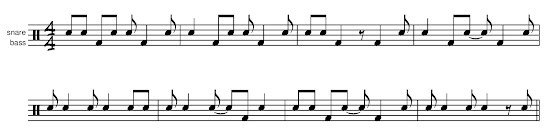
Play the complete book rhythm on the bass drum, but fill in the gaps on the snare drum, to make a full measure of 8th notes. Continue the cymbal as before:  


Alternatively, you could play the book rhythm on the snare drum, and fill in with the bass drum. This will make the one-line exercises more interesting when we do the practice phrase in a moment: 


Practice phrase
Reading from Syncopation, play one measure of rock beat, one measure of texture. The first example above would be played like this— oops, a slight error— the first measure below is the first beat example, the 8/8 measure is the first 8/8 example. I'll correct that later today... 


You can make some more interesting two-measure phrases reading from the full page exercises on pp. 38-45. Repeat any two measures several times. All of these examples have the bass drum playing the book rhythm on both parts:


Of course you can/should also play the full page exercises straight through. As with all of these methods, learn the system well, then improvise.  

Tuesday, January 11, 2022

Groove o' the day: Walk Spirit, Talk Spirit

Alphonse Mouzon's groove from McCoy Tyner's Walk Spirit, Talk Spirit— as he plays it in the live video below, from 1973. The tune was originally recorded on Tyner's album Enlightenment— a 24 minute spiritual journey.  


As it says, he's playing with the snares off, stick in the right hand, mallet in the left hand. He's playing the bell of the cymbal, with the tip of the stick— it's not that piercing shoulder of the stick sound. The bass drum part varies to fit around what the hands are doing; it's there to provide a pulse, it's not really a featured part of the groove. 

Here are some variations in the left hand part he plays near the beginning of the video below: 


The concert video: 


Monday, January 10, 2022

10 and 11 stroke rolls in Wilcoxon's Rolling In Rhythm - continued

Continuing with this nerdly topic of problems with roll notation in Charley Wilcoxon's book Rolling In Rhythm; it should have been the authoritative book on rudimental rolls, but is compromised at times by some very sketchy, archaic notation. Last time we looked at 11-stroke rolls on p. 24, until I got tired of it. Today we'll do the 10-stroke rolls on pp. 25-26. Also check out my old post on 7-stroke roll notation in Wilcoxon. 

Here's the 10 stroke roll in “triplet” / compound meter form. That's it's native form, probably most familiar to everyone as it occurs throughout the rudimental piece Three Camps:  


And here it is in 3/4: 


I'm going to try to find literal interpretations of the following notational weirdness, but most likely, those are the intended forms for all of them— maybe in double time, or in a different time signature, but with the same rhythmic structure. The barely-literate rudimental drummer attitude about notation basically goes ehh just fit a 10 stroke roll into this space. The 1s need to be in the right spot, and that's about it.  

So let's blast off into la-la land, with the next thing on the page:   


With that second ruff of each measure, the book repeats the most problematic thing we saw last time; I believe the double is meant to fall on the beat, and the main note (the last 8th note in the measure) is played a 16th note later than it's notated, like this:


Thus violating the modern universal rule of ruff notation, which is to play the main rhythm precisely, and add the ruff strokes to it— the ruff strokes will fall before the beat, and are usually unmetered. Or course there's no way to squeeze that ruff stroke in between the written 32nd notes and the following 8th note. 

On the next line on the page we have this: 


If that were meant to be played the same as the previous example, it would be a real atrocity— there's not even the ruff notation as a cue that that last 8th note should be played late. Without any other context, I might guess that this was meant to be played with a 16th note triplet pulsation. We see a lot of 8th note length 7-stroke rolls in these studies— this would simply be that, with an extra double at the beginning:


But that would be too fast for the indicated tempo, and there are no other studies using that interpretation— I only suggest it because I'm futilely trying to find a precise interpretation of the notation. 

This also illustrates the ass-backwards (and tempo-dependent) nature of rudimental writing in general. Normally, a musical part indicates a roll, and the performing drummer decides what type of roll should be used, based on the tempo, and other musical considerations, to get the best quality roll. Writing into a part ok, monkey, now roll super fast is peculiar to rudimental writers. 

Now look at this: 


Lots to unpack there. The “open” 10 is played as 16th notes and ends on beat 4; the “closed” 10 ends on beat 3, so we'll have to play it faster to fit it in. They're using the archaic definitions of  open and closed to simply mean slow and fast. In my training, open meant double strokes, and closed meant multiple-bounce strokes— those are the modern meanings of the terms, around here. 

The closed example is a complete mess. First, it violates the note values big time— here is that measure of music without the roll: 


But if you look at the way the roll stokes line up with the bass drum part, the roll begins before beat 2, right in the middle of that dotted quarter note. Going by the previous interpretations, you could play that either of these ways— as 16th notes with that 8th note played late:


...or as 16th note triplets, with the 8th note played as written:


Either of those interpretations put an unnaturally large space between that opening accent and the roll itself, which, again, we don't see anywhere else. Normally with a 10-stroke roll, we expect the starting and ending accents to be at the same pulsation speed as the body of the roll, like in the first two examples.   

And of course playing either of those interpretations at half note = 96 doesn't work at all. So probably what's actually intended is to just play this, or something close to it: 


Clearly we have to relax our modern standards for precision with some of this stuff. Hit the 1 and 3 accurately and get the right number of notes and you're golden. That's close enough, apparently. In fact, these posts seem to have been a very long winded way of saying “traditional rudimental notation was shamefully imprecise, slovenly, and often misleading.”

Sunday, January 09, 2022

Jorge Rossy is stealing my stuff!

UPDATE: Oh, Crisis by Freddie Hubbard is also similar. 

Here's a funny one for you— check out the tune Post-Catholic Waltz from this 2021 recording by Jorge Rossy. 

Now compare with my tune Headlights from this 2000 recording by my group Lower Monumental. 

It's funny how people arrive at the exact same thing independently. I guess there aren't that many notes to choose from, it's unavoidable.

My tune, by the way, was inspired by Charlie Haden's tune Song For The Whales, which is distinctly different, and better.  

Saturday, January 08, 2022

Mel Lewis master class

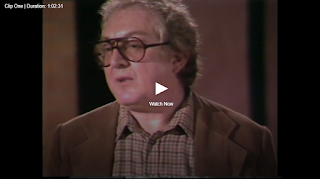
Here's a one hour master class lecture given by Mel Lewis in the early 80s at North Texas State University (now the University of North Texas). Embedding on blogger is weird now, so you'll have to follow that link to watch it. 

Lewis extremely opinionated as always, going into detail about everything that's wrong with everyone and everything. It's good to hear this stuff, without resisting it, whether or not you run with all of it for the rest of your life. He makes an important point around 44 minutes in, that listening to old music is about education— he's not telling you to play like it's the 1930s. You take him seriously, while understanding it's not just about accepting opinions, it's about paying attention to the things the opinions suggest. 

There's an extended sequence about keeping time with the bass drum— “feathering.” This is one thing Lewis says that has become an article of faith today. I still have a more nuanced view of it— soon I'll revisit my old 2012 post on the topic.  

I talk about about the drum set as being a very right handed oriented instrument— Lewis's solo break near the end of the video is a graphic demonstration of that.  

Timely reference: there's a question about Joey Baron— this is early in his career when he was with Carmen McRae. I just played a session with Ed Bennett, who was the bassist in that band. There must have been a buzz about Baron then, that I wasn't aware of. I was younger, and only learned about him later, when he played with Bill Frisell.  

Wednesday, January 05, 2022

Plain talk about fast tempos

“Billy, can we talk?”
Henry Fonda time. I see we need to have this talk again. Everybody wants to talk about ride cymbal technique for blazing tempos. A little perspective on the subject:  

About 15 years ago a couple of friends of mine were moving to New York, and were intimidated that they would not be good enough at playing playing really fast tempos— and a list of whatever hard tunes— so we did some regular sessions to work on that. 

We concluded, after a few months of this: half note = 150-160 was manageable and playable, 165-175 was getting frenetic, above ~ 175 was getting ridiculous and we could barely keep it together. That's the approximate range of tempos on Four & More. 

Many people never play anything faster than about the highest traditional metronome marking: quarter note = 208. They'll say “let's burn one” and then count off ~200 bpm. Most other people rarely get much above ~ Passion Dance / Chasin' The Trane tempo— let's say quarter note = 240. 

Roy Haynes's magic tempo, around half note = 143— the approximate tempo on his famous recordings of Matrix, Have You Met Miss Jones?, Reaching Fourth, All The Things You Are— is extremely fast for most people. I think it's a tempo at which every ambitious player should be able to really kill it— I'll call that normal fast.   

A little above that, we're getting into the high range where the subdivisions are playable and sound like regular notes, fast but not hyperactive. 

At the very high end, half note = 200 is a nice round number, and John Riley mentions it in his book The Art of Bop Drumming, so a lot of  us think of that as the number to strive for as our upper limit. And it's truly absurd. You'll hear things in that vicinity on records occasionally, and usually everyone sounds bad except maybe the guy who's session it is. As fast as those 60s Miles records are, they never get that fast, and they never sound bad like that. 

But I don't know, here's Woody Herman's band playing Caldonia, the tune Riley mentioned, and they keep it together at around 400 bpm. They were a touring band, so they were doing this together every night. And the rhythm section breaks it up by laying out a couple of times, and playing some half time. Bob Leonard is on drums, watch carefully what he's actually doing. Watch what everyone does at these tempos— most often they're not playing a complete, perfectly composed bebop drum part.


More often where those numbers come up in everyday life is when people get called to play with a touring performer, who calls at least one absolute barn burner. That's where normal players get burned— normal excellent players. It's an unfair situation, because they're probably just playing with the guy the one time.  

My principled objection to insane tempos is that they're BS. Speeding something up to the point that “the beat” is really a subdivision, and you're supposed to be creative in a subdivision of that— it's BS. It's not music, it's a jazz-cultural terror weapon.  

[...]

...which is totally irrelevant when you were called to play with Godzilla and he's making you do something insane, and you have to do it because you took the gig and you're on stage and this is happening. You get no opportunity to get up and debate the merits of it. There will be no opportunity to rationally present your position that your priorities were directed at more substantive musical pursuits.


So, I'm not saying don't work on this, just keep it in perspective— who are you going to be playing with, and when. If you want to do ordinary jazz gigs and jam sessions locally, just be very good within traditional metronome range, up to about 208. As a broad rule, everyone should be able to do that. And there is a lot of work to do just learning to play well in that range. That's the point of this entire conversation.

If you're a serious college level student, be pushing that up into that Passion Dance range— sounding very good at quarter note = 250+. You may be called on to hack through something faster than that. 

If you're very ambitious about your playing, and want to play with the very best players in any region of the country, you want to be able to kill it at Roy Haynes tempo. Check out the Pat Metheny record Question & Answer, which has a lot of fast tunes on it— you want to be able to hang with everything on there. When you can do that, that's when you should be thinking about how will I survive when thrust into a super-fast situation.

In fact you'll want to be able to hang and sound good in the full Four & More spectrum— say, half note = 145-175. At least be able to survive at the upper end of that. 

The absolutely absurdly fast range... if you can do these other things, you can probably survive, somehow. I don't know if anyone has that perfectly worked out in the practice room and ready to go in a fully finished state when called upon to do it. Max Roach had to learn to do it on stage, and most of us do not get the opportunity to do that any more.  


POSTSCRIPT: Oh, when my guys got to New York nobody they played with was playing fast, either, and they were all playing ordinary tunes. 

Tuesday, January 04, 2022

More notes on Dahlgren & Fine

I've continued working on the harmonic portion of Dahlgren & Fine's Four Way Coordination— the basic exercises in 4/4, on pp. 15-18— since it's so bloody difficult, I'm writing about it a lot. Around here, extra difficult things demand extra justification. I think this whole area is best for people who can already play, but who want to clean some stuff up, do some foundation work. Regular students, use your judgment.  

I've been drilling the full measure exercises on those pages, at quarter note = 128 (I use a loop from the John Zorn tune Beeroth)— about half the ridiculous half note = 120 that's written in the book. I want to work it up into ~ quarter note = 160s range. See my November post for the easiest, fastest path to being able to play them.  

I orchestrate the patterns on the drum set this way:  

Either hand + bass drum  =  hit a cymbal
Either hand + hihat  =  hit the snare drum 


Adding that movement makes the exercises harder, but more musically logical... which makes them easier. I'm normally oriented around finding the easiest way to do things; this whole area is about practicing hard, inconvenient ways of doing things. Which frees up our mobility when improvising, and builds a stronger framework the other stuff we play. The hyperactive left foot seems to be setting us up for playing uptempo jazz.   

I'm beginning to look for ways of developing Dahlgren & Fine's system further, beginning with the first two numbered systems from page 15— the simplest patterns on these pages, which have either RH/RF together all the time, or LH/RF together all the time.   

Here's the first measure of the first system written in normal notation: 


First two easy things: play all snare drum notes as flams. This is similar to a rock drill I wrote about in 2019. Play left handed flams when the right hand is on the cymbal.  


And right handed flams when the left hand is on the cymbal:


You could also play all the cymbal notes with both hands, with the snare drum played as written: 


An easy thing to do would be to play a 16h note double with the hands on the last note before alternating to the other hand: 


At slower tempos you could do make that double with the feet as well.  

Or fill in a 16th note anticipating an alternating stroke— with the LH when alternating from R to L, or with the BD when switching from L to R: 


This would get pretty complicated on the paradiddle inversion patterns:


Becomes:


That way deserves some more examples— there are some other possibilities that I like a lot. Developing that would be easier if you start with the four note patterns— half a measure. 

Another way, which is similar to what Joe Morello does with Stick Control, in his own Master Studies books, you can fill in all the spaces with the opposite hand or foot, to make 16th notes. Again, I fill with the left hand and right foot only: 


Or Morello's way— he doesn't fill between alternating strokes: 


Just some ideas. Obviously it becomes much more complex after the first two systems on p. 15, where you may have either hand playing in unison with either foot within a single pattern. 

The idea with thinking about these variations is not to create more things to practice, but just to be aware of some natural directions the original patterns can go in actual playing. I might mostly practice the book patterns, and momentarily try these out while doing that, to be able to make that direction change; and to see which make sense to practice on their own.

Saturday, January 01, 2022

Subtractive patterns for jazz snare and bass

Continuing to develop this subtractive method, here are some good patterns for snare drum and bass drum in a jazz feel. I'm digging the system. It allows me to put whatever part I want consistently in rhythmic places that don't happen regularly in the other common Reed methods. The density of the rhythms in Reed has also been an annoyance— this method allows me to break them up between parts of the instrument in ways I like— in a jazz feel, I can get a level of snare drum density I like.  

Use pp. 10-11, 30-32, and 34-45 in Syncopation. Play the regular jazz rhythm on the cymbal, plus hihat on 2 and 4 with the foot. The patterns below represent one measure of 8th notes; you play the top line book rhythms on the drum indicated for the corresponding note in the pattern. There is a fuller explanation here. 

For example, here's how you would voice the first two lines of Exercise 2 (p. 39), using the SSBS SBSS combination pattern below:


Warm up patterns:

BSBS BSBS
SBSB SBSB
 
SSBB SSBB
BBSS BBSS

SSSB SSSB
SBSS SBSS

BSSB BSSB 
SBBS SBBS

SSSS BBBB
BSSS SBBB


Combination patterns— similar alternates are on the same line: 

SSSB SSBS / SSSB SBBS
SBSB SSBB
SSBS SBSS / SSBB SBBS
SSBS SBSB
SSSB SBSB

We don't need many combination patterns. The possibilities are endless, but the real practical range is limited. The differences between patterns will be most apparent on the denser one line rhythms, and the horrible Exercise 2 on p. 39. 

And note: it is easiest to write these systems as sticking patterns, but when you're practicing it may be easier to think in terms of a verbal rule. For example: 

SSSB SSSB = bass drum on any & of 2, & of 4, the rest of the rhythm on snare drum

SSSS BBBB = first half of the measure on snare, last half on bass drum

The verbal rules are complicated to read, but easy to think. The sticking pattern form is easier to read, harder to think. With the more complex patterns you'll have to figure out your own strategy for thinking your way through them. It's easier than it seems, once you've done the warm up systems.  

As always, the idea is not just to pile on more stuff to practice, it's to have a thorough concept of a system, so you know how to work on what you want to work on, whenever you actually want to do it. So at whatever point in the next 30 years it occurs to you man, my bass drum doesn't hit the & of 2/& of 4 very well, you can break out the SSSB-SSSB pattern and really work that out.