I finally got to record with the 22" Sabian Raw Ride I was so excited tell you about awhile back. I'd say it has an unmistakable "A" sound- neutral-seeming, but very pretty, with a lot of definition, though it's not a super dry cymbal; as I mentioned before, the wash seems to be in much lower frequency range than the stick sound. The rivets are nice, since it's not a real complex-sounding cymbal by itself. For comparison, the cymbal you hear during the fade in, and again at around 1:27 is my 22" Bosphorus Turk Original Ride, which is close to the same weight as the Sabian- maybe slightly heavier. The hihats are 13" Bosphorus Turk Regulars.
This is off of my new record of the music of Ornette Coleman, Little Played Little Bird, which will be coming out on Origin Records in 2012. You can pre-order is from the sidebar under the "help keep us operating" heading. Personnel is Tim Willcox on soprano saxophone, Weber Iago on piano, Bill Athens on bass, me on drums.

A drumming blog written by Todd Bishop.
Wednesday, November 30, 2011


Monday, November 28, 2011
A bargain on a great book - UPDATED

I couldn't resist bringing this to your attention- Joel Rothman's Compleat Jazz Drummer is currently available at less than half price at Amazon.com- $45, when it normally goes for $90-120. It's not exactly commonplace, so forget about finding a used copy. I've been meaning for months to do a review, but you'll forgive me for finding writing about this 500 page behemoth a little daunting. I think the only way I can deal with it right now is just to make a laundry list of what it is/what I like about it.
Here we are, in no particular order:
1. Takes the Chapin-style of jazz book just about as far as it can go. Contains coordination/comping patterns for one, two, or three limbs in a variety of feels- triplets/swing 8ths, 16ths/even 8ths, double-time feel, 12/8 feel. That last is, I believe, the key to understanding and copping Jack Dejohnette's elusive fast-within-slow thing. So you can be the first kid on your block to nail that one.
I believe- but haven't gotten confirmation- that Dejohnette may have actually worked with Rothman's materials in developing that. I haven't seen similar materials anywhere else, and this book is one of two drum books referenced in the Dejohnette/Charlie Perry book.
Read on:
Sunday, November 27, 2011
Something key

In Dawson's approach, as presented by McCaslin, it's treated as a melodic idea, in the bebop fashion- the recurring dotted quarter (and rhythms derived from it) is something of a special occasion within distinctly 4/4 bop playing. In post-60's playing, I regard it as more or less ever-present, whether it's stated directly or not- I may be a little bit of an extremist that way. It's often used (and abused) as a tension-producing device- "metric modulation", the currently popular pre-packaged indicator of amazingness, is the most egregious example of this.
This isn't exactly a how-to piece, but you can begin to introduce this into your playing by following the instructions at 4OTF, by getting very familiar with the way 3/8 and 3/4 lay against various 4/4 phrases, by getting your snare drum stuff together in 3/8 and 3/4 (here's a clue for how to begin applying that to the drums), by studying the difference between/similarity of 3/4 and 6/8, and especially by doing a lot of listening to the great drummers since the 1960's, including Elvin Jones, Roy Haynes, Jack Dejohnette, Bob Moses, Billy Hart, Jon Christiansen, Barry Altschul, et al, and to African, Afro-Cuban, and Brazilian drumming. I didn't say it was easy...
Saturday, November 26, 2011
Occasional Blakey: Afrique
While I put myself back together after a long holiday in Seattle with the family, here's a favorite old Art Blakey track, Afrique, from the album Witch Doctor, written by Lee Morgan. Buy it.
Tuesday, November 22, 2011
Podcast - Episode 5 - Paul Motian
A small collection of performances by the great master we lost today. You can also listen to it at the Podomatic site, or download it as an mp3.
Track list after the break:
Track list after the break:
Paul Motian 1931-2011

Update 2 - more notices:
Jazz Times obituary
Said saxophonist Joe Lovano, who worked often with Motian over the past three decades, “Paul was a strong, charismatic character, with a lot of energy and passion. He had a complete sphere of energy that you can hear in his playing, which could shift and change moods in a nanosecond. He was very serious and funny at the same time. He was a beautiful, creative soul, with so much love and passion.”
Allaboutjazz.com obiturary
Emerging first as a member of pianist Bill Evans' groundbreaking trio in the mid-1950s, Motian went on to become an innovator in his own right, creating a style of drumming that was as much about implication and suggestion as it was overt pulse and groove. Texture and color were paramount from a drummer who, in addition to recording in groups like pianist Keith Jarrett's vastly influential American Quartet of the 1970s, with bassist Charlie Haden and saxophonist Dewey Redman, went on to create his own vast discography.
NPR's A Blog Supreme
Though little known outside jazz circles, his career, well over five decades long, helped change the role of drums in jazz. His deep internal sense of swing, and the beauty he could create from colorful, occasionally spare accents, made him among the most respected musicians in his field.
More after the break:
Monday, November 21, 2011
Favorite albums: Special Edition by Jack Dejohnette
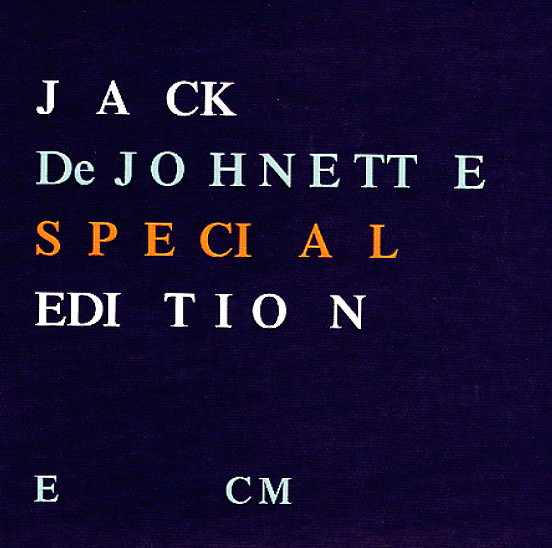
1980 - ECM 001161902
Arthur Blythe - alto saxophone
David Murray - tenor saxophone, bass clarinet
Peter Warren - bass, cello
Jack Dejohnette - drums, piano, melodica
It's been awhile since I've done one of these, which is bad because records are pretty much the most important thing in the world. Do not succumb to this current thing of buying individual mp3s. With jazz you need to buy complete albums and listen to them all the way through.
So, today we have the purple record. I've been hearing a lot of mannered, emptily virtuosic music lately, and listening to this record again blows it all out of my consciousness nicely. It feels very true. Includes two Coltrane tunes: India (my favorite track), and a drumless Central Park West. There's also the post-modern Zoot Suite, the spaced-out Journey to the Twin Planet (with a fun surprise a couple of minutes in), as well as the classic Dejohnette composition One for Eric (dedicated to Eric Dolphy). Blythe and Murray aren't Chicago guys, but there's a distinct Chicago vibe to their playing here which works very well for the ensemble- though I guess it's not the sort of playing that gets most sax players excited. I can't think of more classic examples of Dejohnette's playing than the blowing on Zoot Suite and India.
It appears that no part of this record is on YouTube, so you'll just have to buy an mp3 of India to get a taste of it, as long as you promise to purchase the whole thing.
Sunday, November 20, 2011
The Ed Blackwell story
From Branford Marsalis' NPR show Jazz Set, Don Cherry, Charlie Haden, Billy Higgins, Joe Lovano, Max Roach and others talk about Ed Blackwell. Glad to see this resurface- I remember being glued to this, and cursing having missed parts, when it aired in 1998 or so. In eight parts.
Part 1:
Parts 2-8 after the break:
Part 1:
Parts 2-8 after the break:
Bass drum variations for bossa nova
Bossa nova can be a very static style for novices- I've noticed in teaching that they have a hard time getting away from the standard, repetitive pattern. And, aside from Ed Uribe's book, I really haven't seen much in the way of methods for developing it. So here's a page of exercises which will help to open up the bass drum part, and to become more flexible in general with this style.
The usual place you would use the variations would be at phrase endings, or freely during the body of the tune, if you want a more open feel. I've written them in a two-measure format to give context, with the standard bossa pattern at the beginning and the variation at the end; in performance you would play the variations much more sparsely. It would be very unusual to play these exercises exactly as written (that is, as repeated two-measure vamps) in actual music.

These will tend to give your bossa a little more funky and samba-like feel, which won't be appropriate for every tune or situation. The bass drum is usually handled very delicately in bossa nova, so apply this with a lot of sensitivity. The variations can be treated somewhat as light fills, and played a little stronger than the body of the groove. Doing a lot of listening is vital, of course.
Get the pdf.
After the break are some practice suggestions:
The usual place you would use the variations would be at phrase endings, or freely during the body of the tune, if you want a more open feel. I've written them in a two-measure format to give context, with the standard bossa pattern at the beginning and the variation at the end; in performance you would play the variations much more sparsely. It would be very unusual to play these exercises exactly as written (that is, as repeated two-measure vamps) in actual music.

These will tend to give your bossa a little more funky and samba-like feel, which won't be appropriate for every tune or situation. The bass drum is usually handled very delicately in bossa nova, so apply this with a lot of sensitivity. The variations can be treated somewhat as light fills, and played a little stronger than the body of the groove. Doing a lot of listening is vital, of course.
Get the pdf.
After the break are some practice suggestions:
Subscribe to:
Posts (Atom)