Monday, April 30, 2012

Three Camps round up

I recently picked up a stack of Mitchell Peters books, one of which contains several variations on this classic, and it seemed like a good time to round up the various sources and variations on it. In case anyone doesn't know, Three Camps is a military drumming piece over 200 years old, based on rolls and accents in a triplet rhythm. I've been playing it since drum corps legend Ghost (known to his mother as Bill Linen) taught me an unusual (possibly mis-remembered) version in 1982. Since at least Charles Wilcoxon's day, drummers have been using it as a template for working on other things- accented singles, paradiddles, ratamacues, etc. Here's what I could find online and in my own library: 


Books

The Moeller Book, and Haskell Harr Drum Method, book 2
Each of these has it written out in the archaic notation, with an unusual ending in Harr- two 5-stroke rolls plus release. Due to the notation they're pretty useless to modern users readers.

Rudimental Swing Studies for the Advanced Drummer by Charlie Wilcoxon
In traditional form, paradiddles, and ratamacues. Unfortunately both the original edition and the typo-riddled Sakal edition present it with the old-fashioned notation, though it's marginally more readable than the Moeller version. (To be fair to Mr. Sakal, I think there are many more typos in his edition of Rolling in Rhythm than in RSS. Still looking for an original edition of RIR to confirm that...)

Intermediate Snare Drum Studies by Mitchell Peters
Includes the usual triplet roll form (in modern notation), and in rolls with a 16th note, quintuplet, and sixtuplet pulsation.

Variations on Three Camps by Marvin Dahlgren
This was an unexpected find. I was continuing my so-far-in-vain search for a copy of Dahlgren's Drum Set Control, and came across Really Good Music, which publishes his books- including DSC. According to the site: "The first half of the book is designed primarily for Snare Drum. The second half is designed for use with Drum Set. As usual with Marv Dahlgren books, one can easily spend the rest of your life perfecting these patterns. This 61 page book is in easy to read manuscript with sticking patterns indicated." Naturally I ordered a copy- along with DSC and a book I had never heard of, Complete Text for the Rock & Roll Drummer. I'll let you know when I get them.

Variazioni in Three Camps by Daniele Sabatini
Never seen this before. Ten different variations. No information on what they are, but the preview has it written in flamacues. Available through a German site.

Online versions after the break:

Sunday, April 29, 2012

DBMITW: Cecil Taylor

Here's another old free jazz favorite from my LP stacks. Andrew Cyrille is on drums. And the title (CONQUISTADOR!) has an exclamation point, which I like.

Transcription: Elvin Jones - Out of this World

Here's another example of Elvin Jones' "afro-waltz"- as I keep calling it- from the intro of the tune Out of this World, from the John Coltrane album Coltrane:


The dotted-8th/16th rhythm you see a couple of times could've just been notated as swing 8ths, but I did want to illustrate that Elvin did not just play an even triplet grid, and that many of the "organic" sounding things in his playing are actually accurately-played 16th notes. But in practicing this, you can treat the dotted 8th/16ths as regular swing 8th notes. There are other little manipulations present which for readability I haven't notated- for example some of the unisons landing on the beat are played very wide, with the hihat landing slightly before the beat, like a flam.

At the end I've isolated a barline-crossing move he does- which can help keep this type of groove from becoming too static- and a couple of examples of the basic groove- one busy and one simple- which is similar to the groove from Your Lady which I presented before, with the same 6/8 part happening between the feet and left hand, and the hihat played on the 1-& of the second measure. I've eliminated the tom moves to show the idea cleanly; you can copy the moves from the transcription, or improvise your own, or apply the moves I gave earlier.

See my book, or the blog archives for last year's transcription of Tunji, also from this record.

Get the pdf

YouTube audio after the break:

Saturday, April 28, 2012

Developing Elvin's Afro-Waltz, part 2

I've been doing a lot of this sort of thing in my own practicing lately- practicing snare drum variations vs. a cymbal/hihat/bass drum ostinato, via Dahlgren & Fine, and my own materials. Ralph Humphrey's Even in the Odds sets up a similar thing, which we'll be working with soon. So here's a variation on Elvin Jones' afro-waltz groove from Your Lady, using my favored hihat part for a jazz waltz, the 2 and the & of 3. I've filled that to make a 6/8 SD/BD/HH part similar to Elvin's groove, and then given the snare drum variations to fit with the other parts.


See the part 1, and my suggested tom tom moves for ways of practicing this. And listen to a whole lot of Coltrane, starting with Live at Birdland, and Coltrane.

UPDATE: Wow, there were way too many typos in there- updated the pdf to correct them.

Get the pdf.

Wednesday, April 25, 2012

DBMITW: A Message From Trane

This swings in that avant driving your 1970 Buick Elektra off a cliff at 90 mph kind of way. It's from a record I used to listen to a lot, but which has been languishing in my stacks for many years: Steam, by Archie Shepp- with Beaver Harris on drums and Cameron Brown on bass. I'm listening to it on vinyl now:

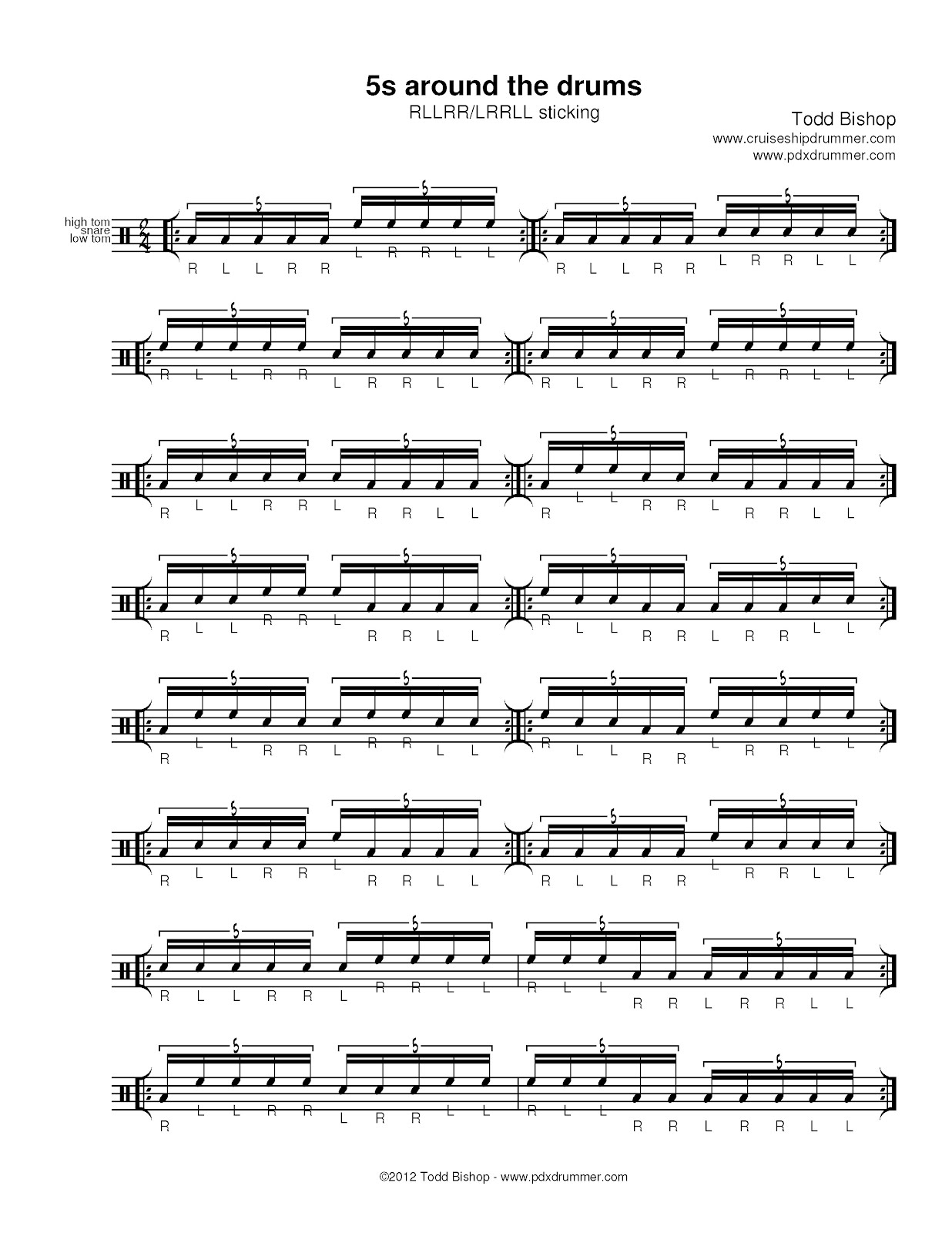
5s around the drums

I've enjoying practicing my previous around-the-drums things so much, I thought I'd run it through a few iterations- similar to my multi-page paradiddle exercise- and see what we get. Today it's 16th note 5s, using  the easily-flowing RLLRR/LRRLL sticking:


As I've outlined previously, once the single measures are happening, start combining measures- the notes in parentheses are to facilitate that without having to do a crossover. On the second page I've also given some formats for playing these as 8th notes or 16th notes in 5/4 or 5/8.

Get the pdf

Monday, April 23, 2012

Transcription: Paul Motian - Israel

UPDATE: Download link working now.

Here are a couple of famous drum breaks by Paul Motian, from Israel, a 12 bar tune on Bill Evans' Explorations; Motian and Evans trade choruses before the head out. Note that even though the tune is played with a swing feel, most of the 8th notes on the solos are played straight- listen closely to the recording to hear where you should swing them.

Get the pdf

YouTube audio after the break:

DBMITW: Tootie Heath

OK, there's always time to do one of these. Here's Tootie Heath playing with Dexter Gordon:


Tootie was living in LA when I was in school down there- my combo leader Dwight Dickerson was in his group, and on one occasion they brought him in for a master class. My main takeaway was his response to bassist Jesse Murphy's question about strategies for playing without a drummer, a mode of music making Tootie described as "like masturbation."

Sunday, April 22, 2012

Phew

It's been a heckuva week- between releasing a new CD, playing the Ballard Jazz Festival, taxes, and a simultaneous plumbing and roof-leaking emergency in the little rental unit behind my home- and I now need to both take it easy for a couple of days and dedicate a bunch of time to booking my fall Europe tour. So I'll be keeping a low profile here for a moment. I invite you to visit my other new blog with news about my musical projects, currently my CD of the music of Ornette Coleman, Little Played Little Bird, or peruse our absurdly bountiful archives....