Showing posts with label 6/4. Show all posts

Wednesday, December 13, 2023

Hemiola inverted and combined

An easy page of rhythm exploration here, inverting a polyrhythm, combining inversions, and then inverting that. I've been encouraged to write these things after noticing that, starting with a simple 3:2 polyrhythm (or hemiola), running some simple mathematical permutations, and/or putting them into 2/4 or 4/4 time, we get some very common rhythms in north American and Latin music. 


There's no grand goal here, except to know rhythm a little better. Most people can play it in one or two practice sessions, then leave it. 

I encourage you to count the combined rhythm of each exercise, and think of them as sticking— variations on B RLR (B for both hands in unison). As we get into the inversions there are some RLRLR and RLB. Play first with hands only, then add the bass drum at the beginning of the pattern.

You can move your left hand between drums, and add some more bass drum. Try some things, it won't be difficult to make some interesting Afro-type grooves with this.   

Get the pdf

Thursday, May 18, 2023

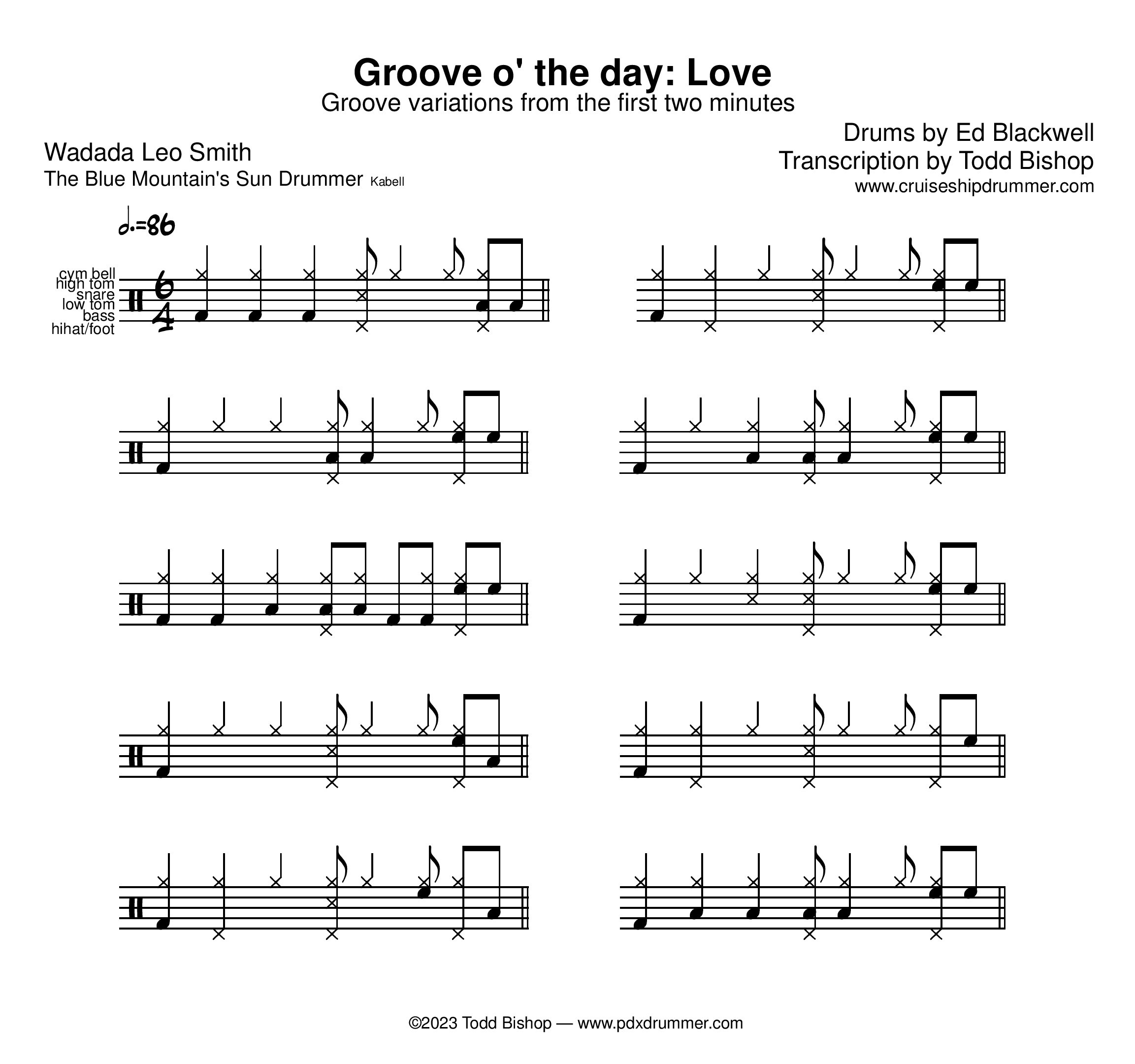
Groove o' the day: Ed Blackwell - Love

Here's a fast 6/4 Afro type of groove from Ed Blackwell, on the track Love, from a duo record with Wadada Leo Smith, The Blue Mountain's Sun Drummer. There's no tune, it's just free blowing over a groove. People should do that more. These are some variations from about the first 90 seconds of the track. 


We're in kind of a compound 6/4 here— the dotted half note gets the beat, at about 86 bpm. Or if you're counting quarter notes, ~260. 

Get the pdf

Saturday, December 03, 2022

Page o' coordination: Juju

I'm transcribing a little bit of Elvin Jones's playing on the Wayne Shorter tune Juju, which I originally did off the LP around 1988. It'll take some time to finish it, so here's a page developing the main groove from it— a version of the thing I've been calling an “Afro waltz.” Most people would probably say “Elvin waltz.”

Slightly different format from the usual POCs, exercises 1-10 build the particular groove Elvin played on the recording, and have specific drums assigned, including some changes to the bass drum rhythm. Exercises 11-18 have other left hand rhythms for basic fluency. 


Swing the 8th notes. Practice with and without the tie on the cymbal rhythm in the first measure. On exercises 11-18 you can do the stock left hand moves I use with these pages. 

Get the pdf

Here's the tune, it's a record you should know well:

Wednesday, December 11, 2019

Practice loop in 6/4: Journey In Satchidananda

Another groovy practice loop, sampled from Journey In Satchidananda by Alice Coltrane. It's a slow, 97 bpm swing feel in 6/4— good for getting into both of my ways of doing Chaffee's jazz thing, as written as triplets, or as 8th notes in 3/4.

The time fluctuates a bit at the beginning of the sample, before the drums come in. A couple of beats just drag a bit, and I found it not to be a problem. It sometimes happens in playing that the group decides to make a beat too long, and you have to adjust. I probably wouldn't want to be practicing to something that rushes, however.


Monday, September 30, 2019

Page o' coordination: Tekufah rhythm

Page o' coordination using the rhythm from the bass line on Tekufah, a John Zorn tune from which I recently made a practice loop. The cymbal rhythm is actually an inversion or mode of the normal Afro 6 “short” bell rhythm— the rhythm here starts on beat 4 of the short bell rhythm. I'm not aware of any other recording using this rhythm, but playing it this way does give a little more clarity on the structure of the short bell thing— two beats of shuffle rhythm, two beats of middle-of-the-triplet rhythm.

This is a little gratuitous to me, actually— I've posted a lot of stuff for this same basic Afro 12/8 groove, and anyone who learns maybe two or more of the Pages o' coordination for it should have this style covered for all practical purposes. The returns get smaller and more subtle as you practice more pages. But to me this is a very deep area of drumming, which carries over into other areas of my playing, so I work on it a lot. Still I probably won't use this page on more than a few practice sessions.


I say the same thing about every POC, so read the following in a weary, exasperated tone:

1. Learn the page.
2. DRILL the page, doing stock left hand moves.

Get the pdf

Friday, September 06, 2019

Page o' coordination: basic 6/4

The first of three pages of fundamentals to go with that John Zorn loop from the other day. These POCs are a major part of my output right now, which is a little bit misleading— I only write them and use them for things would be too difficult to practice with an interpreted, Reed-style method. It's better to do the bulk of your practicing with the Reed methods.

This page has a 3:2 polyrhythm played between the left foot and right hand/right foot in unison, with left hand “independent” parts added. It's written in 6/4, but it could easily be felt in 12/8 by feeling the cymbal/bass part as your primary pulse.


Learn the whole page with your left hand on the snare drum, then drill it by playing the page with my stock tom moves. When doing the moves, I play rim clicks on the snare drum notes.

Get the pdf

Tuesday, September 03, 2019

Practice loop in 6: Tekufah

A fun practice loop in 6/4 with a strong suggestion of 12/8. It's really a compound pulse where it's both things at the same time. Hit the time signature labels at the bottom of the post for practice materials to go with this. You also need to have my book Syncopation in 3/4. Any easy thing you want to do with that book would be great to practice with this.

Friday, July 26, 2019

Groove o' the day: Chico Hamilton waltz

Here's Chico Hamilton playing his version of an Elvin-type waltz in 1962. I've always assumed it was Elvin's thing, that everybody else was copying. Maybe it was a type of groove everyone hip was doing, and Elvin just did it best. Chico Hamilton was an LA player who was not particularly highly thought of as a drummer, but he was a successful bandleader and had a lot of high profile people pass through his group in the 50s and 60s.

This is from the first section of the tune Lady Gabor, from the album Passin' Thru. I found this in my dad's record collection, and was surprised to meet the trombonist on it, George Bohanon, in the jazz department at USC. George was a grad student at SC when I was there, about 25 years after this recording.


Swing the 8th notes. That third tom tom note on beat 1 of the second measure happens occasionally; often he plays it almost inaudibly. Hamilton plays this pretty repetitively.


Saturday, January 12, 2019

Practice loop in 6/4: Magdalena

Practice loop in 6/4 sampled from Magdalena, from John Zorn's album O'o. Tempo is quarter note = 204, and there is an extra bar of 3/4 on the big figure at the end of the form— you'll hear it.

Use this with any of my materials in 3/4 or 6/4, the “latin in 3” pages o' coordination, and especially the Free Design figure control page, which is based on the same rhythm as the bass line here. You can also use this with my new book Syncopation in 3/4. What a wonderful idea!

Tuesday, July 24, 2018

Page o' coordination: Afro 6/4 - triplets

Here we have our standard Afro-Cuban bell pattern extended a couple of beats to put it in 6. This page will work well with that Jimmy Garrison loop from the other day. Pairs well with a couple of pages of similar stuff in 9/8 from 2014, too.


Run each pattern many times. I like to move my left hand around while practicing these pages— either every note, or on every single or double. I find it's good to vary your technique, dynamics, and timbres of all the parts.

Get the pdf

Sunday, July 22, 2018

Practice loop in 6/4: Greensleeves

Practice loop in 6/4, sampled from Greensleeves, recorded by John Coltrane on the album Africa/Brass. Here we just have the bass line played by Jimmy Garrison. Tempo is 142 bpm.

Garrison is phrasing the 6/4 as 2+2+2/4, but you can do all of my Elvin Jones-type stuff in 3 with this. This “figure control” page based on Stereolab's Free Design actually uses a very similar rhythm to what Garrison is playing here, just add a swing interpretation. Also see my other stuff in 6/4.


Sunday, September 17, 2017

Practice loop in 6/4: Lilin

Here's that practice loop for yesterday's Figure Control page in 6/4, sampled from Lilin, played by John Zorn's Masada. The tempo is a little easier than the other recent loop in 6.

You'll also find this useful for working on any harder triplet coordination materials you may be struggling with— I've been using it to walk through the triplet “harmonic” independence portion of Dahlgren & Fine, or the jazz independence portion of vol. 3 of Gary Chaffee's Patterns series. Just make the first three notes of the practice loop the rate of your 8th note triplet. That puts your quarter note at about 65 BPM.


Saturday, September 16, 2017

Figure Control: 6-4 - Lilin - 01

Let's just assume every post begins with an apology for the light posting— I've just been very busy with playing, teaching, and getting ready for an art show this past few weeks.

This Funk Control/Figure Control/Whatever Control format I've been working with lately is proving to be quite a useful concept— taking interpretations commonly applied to Syncopation, and using them with a single rhythm, and then combining them. Today we've got another rhythm in 6/4, based on the bass vamp from Lilin, a tune played by John Zorn's Masada.

There will be a practice loop to use with this page forthcoming in the next couple of days. The tempo is more reasonable than that of the Free Design loop we used with the previous page in 6.


Play through the base rhythm and iterations at the top of the page once,  just so you can be familiar with the foundations of the lettered exercises. Then learn the individual lettered exercises, repeating each of them many times. Then practice combining lettered exercises, in the following template:

A-B, A-C, A-D, etc... B-C, B-D, B-E, etc... C-D, C-E, C-F, etc...

Follow that system until you've played all combinations of patterns. Note that you don't have to work backwards; when you get to the combinations starting with B, you don't have to do B-A, because you already did A-B when you did the As.

With each combination, play each component pattern one or two times, repeating the entire combination phrase many times:

||: A-A-B-B :|| 
||: A-B :||

With all of the pages in this series, there are so many exercises and combinations of exercises to learn, that if you really have a problem with any of them at a certain tempo, there's no problem with just cutting those exercises from your routine. Learning to play the exercises is just the first part of this system— what's more important is learning to combine whatever patterns you can play really well. There's no point in including a pattern you're really struggling with in practicing that part of the system.

Get the pdf

Friday, August 18, 2017

Figure Control - 6/4 - 02

Another page of Funk Control type exercises for use with my Stereolab/Free Design practice loop. We're calling this portion of the series Figure Control since it's not really funk, and we're basing the exercises on a specific rhythmic figure— I'm still working it out the concept. The practice variations are slightly different from the first page in 6/4, too. The tempo of the Stereolab loop is pretty cooking, so you might find a slower one to work these up.


You remember the methodology: learn each of the lettered practice exercises, and play them many times, say for one minute each. Then combine them; play every combination of patterns:

A-B, A-C, A-D, etc / B-C, B-D, B-E, etc / C-D, C-E, etc

For whatever letter exercise is first in the combination, you only have to combine it with letters that come after it. For example you don't have to practice B-A, because you already did A-B when you practiced the As.

Play each exercise in the combination one or two times; play the sequence many times:

||: A - B :||
||: A - A- B - B :||

The cymbal part in the exercises can be played on any cymbal; if an open hihat is indicated, play that exercise on the hihat. The drum parts can be played on the snare drum or moving around the drums.

Get the pdf

Tuesday, July 18, 2017

FIGURE CONTROL: 6/4 - Free Design riff

Stretching the concept of my Funk Control series a little bit. Here we're just doing some basic orchestrations with a rhythmic figure, the vamp in 6/4 from Stereolab's The Free Design, which I posted before as a fun practice loop.


The idea behind this and the Funk Control series is to learn all the patterns, play them many times, then do all possible combinations of patterns using the following logic:

A-B, A-C, A-D... B-C, B-D, B-F... C-D, C-E... etc

Play each combination many times, playing each component pattern one or two times:

||: A - B :||  or  ||: A - A - B - B :||


Feel free to move your hands around the drums and cymbals. The cymbal part can be played on the ride cymbal or hihat— obviously any that include open hihat must be played on the hihat. There are some places where the hands are in unison; feel free to play the right hand on a tom tom instead of the cymbal. The part written on the snare drum line in the middle of the staff can be played on the snare, or on any drum.

The first two lines just illustrate the foundation rhythm, and the basic orchestrations from which the other orchestrations are derived.

Get the pdf

Sunday, June 25, 2017

Practice loop in 6/4: The Free Design

A fun practice loop, in a fast 6/4, sampled from The Free Design, by Stereolab. Tempo is about quarter note = 217 BPM.


The rhythm for the bass vamp:


Have fun. This loops seamlessly, if one were to use one of those audio-ripping browser extensions, and put it on one's mp3 player... 

Tuesday, March 28, 2017

Linear phrases in 3/4, mixed rhythm - 01

More pages of Gary Chaffee linear patterns, in two measure phrases in 3/4, with 8th notes and triplets. If I was about doing things in a logical order, I would have done these pages a long time ago, before doing the same idea in 5/4 and in 7/4. Having worked with those earlier pages quite a bit, these feel a bit redundant to me, but maybe you'll have a use for them, or maybe you were scared off of working on them before because of the odd meter, and the 3/4 will work for you. Dunno.


Use the stickings at the top of the page— you can reverse them, or improvise the stickings, but I think it's a good idea to become extremely solid with the basic RH-lead way. Move your right hand to any drum or cymbal, left hand stays mostly on the snare, but can also move around. Practice getting out of the patterns, with a bass drum and cymbal on 1, or on the last note of the pattern. These could also be played with a swing rhythm. Also see my previous pages of one measure linear phrases in 3/4.

Get the pdf

Tuesday, January 12, 2016

Page o' coordination: Afro 6 - 6/4 feel

Another Afro 6 POC. It's a very rich and rewarding style, which is why I do so bloody much stuff with it. I was surprised to see I had never written up this variation before— it seems obvious. The BD/HH part, which suggests 6/4 or 3/2 across the primary meter of 6/8, is not authentic to the Cuban music that is the source for this groove— not that I am aware of. We're doing this just to open up other possibilities, and increase awareness of the major cross rhythms.


Like I said only yesterday, do the left hand tom moves when you practice this.

Get the pdf

Tuesday, November 17, 2015

Transcription: Joey Baron — Cattle Drive

A little transcription of Joey Baron playing in Bill Frisell/Americana mode on Cattle Drive, from Frisell's original music for the Buster Keaton film Go West. It's sort of a beginner's version of the ricky-ticky thing he does on tunes like Pip Squeak. like I've written it in 6/4, but you can just think of it as a waltz. The theme and solo form is 9 bars (of 6/4) long.


Baron uses more sounds than normal on this— including cowbell, woodblock, and an unidentified sheet metal sound— check out the key at the end. Virtually the entire cymbal part is played on the crash cymbal. He generally plays a lot of different articulations— rim shots, buzzes, and a lot of things that are difficult or impossible to transcribe, but here he's pretty straightforward.

Get the pdf


Sunday, March 01, 2015

Brazilian 3

Continuing our recent batch of downloads for odd meter Samba and Bossa, here are some parts for putting together some grooves in 3/2, or in 6/4. This isn't an incredibly odd meter for Samba, but it is non-traditional— if a thing people have been doing for at least 50 years can really be called that. We could say these meters are non-folkloric, but I'm resistant to thinking of Samba as folkloric music in the first place— it's a modern, commercial, urban music approximately as old as jazz, with the same tradition of innovation, and with an institutional apparatus, and professional class of performers and composers. To me it's significant that Pelo Telefone, the first important Samba recording, from 1916, referenced the modern technology of the time.

With that little bit of perspective, here are the rhythms. Again, I encourage you to get my book Playing Samba and Bossa Nova (print / e-book) for my complete practical introduction to these styles. Our brother blogger Adam Osmianski is also writing a lot of stuff about Brazilian drumming, which you should check out.


Practice the left hand parts with all combinations of cymbal/feet parts, then pick a few favorite left hand parts, and improvise variations on them. Play the left hand as rim clicks on the snare drum, at first, then experiment with moving around the drums, with different timbres and dynamics— rim shots, buzzes, accents, dead strokes. Play the cymbal part on the hihats or ride cymbal, or on the snare drum with a brush— ignoring the open/closed hihat indications in those latter two instances, of course. Generally you'll use the second bass drum pattern as a variation, rather than as a repeating part of the groove.

Get the pdf

A few recorded examples after the break: