Friday, May 12, 2023

Finessing Reed funk phrases

A baseline thing to do with Reed funk methods is to practice in two measure phrases. For example: one measure cut time funk* / one measure RH lead**.

* - CUT TIME FUNK: Reading from Syncopation, play melody rhythm on bass drum, except play the 3 on the snare drum— adding it to the written rhythm if necessary—add quarters/8ths on cymbal. 

** - RH LEAD: Play melody rhythm on cymbal with RH, plus bass drum in unison. Fill in gaps in rhythm with LH on SD to make a full measure of 8th notes. 
 
Here's how you would play that phrase reading line 1 on p. 34 of Syncopation— look it up, the rhythm is 1& &3 4:  


As you get deeper into practicing that, especially when running the full-page exercises, that formula creates some rather artificial connections between the two measures— the resulting thing is not how I would play. Or maybe there are some hipper possibilities, that move more naturally. We'll look at some examples of that from Exercise 1 on p. 38 of Syncopation. 


You could play the page straight through, or isolate any two measures and repeat them. Let's isolate measures 2-3 of line 2:


Played strictly first measure: cut time funk / second measure: RH lead: 


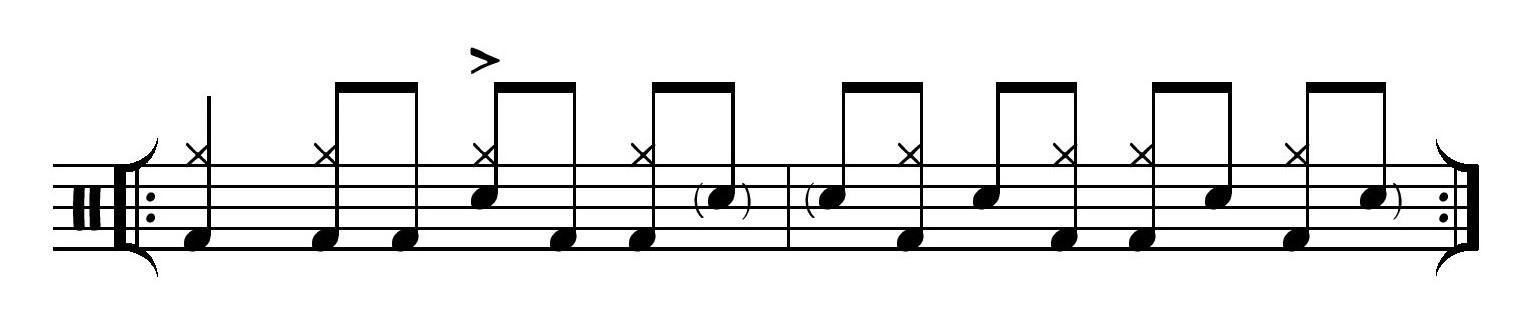
It's kind of weird to just start a measure with a ghost note. You could accent that note instead, or just start the RH lead portion earlier, on beat 4: 

With measures 3-4, also on line 2: 


Played like this with the straight formula: 


On the repeat, we're hitting the cym/bd on the & of 4, and cym only on 1. I'm more inclined to put an accent on that & of 4— let's do it on an open hihat, closing it on 1. 

I'll also start the RH lead part early, as on the last example:  


The first two measures of line 3: 


By the formula: 


Like with the first example, I would start the LH filler early. And if I wanted to play a crash on 1 at the beginning of the phrase, I would not hit the cymbal along with the bass drum on the & of 4 at the end. The 4 at the end of the phrase would be a natural place to accent the snare drum, as well:  


Some ideas to think about. This covers most situations you'll encounter practicing from Syncopation. Maybe there will be spots where you'll want to figure your own thing out. Always feel free to make your own alterations. These types of practice systems are neither perfect nor sacrosanct. In a sense the point of practicing is to learn new stuff, but it's also to learn it in a way that connects to what you already know how to do. 

Wednesday, May 10, 2023

CYMBALISTIC: 20 BLOW-OUT

5/26 UPDATE: OK gang, the special is OVER, but, happily, the cymbals are still a tremendous bargain considering that a) they're great, b) you'll use them forever, c) they're not that expensive to begin with! 

By the way:
I also have two more of the super-cool thin 22" Extra Special Janavars in stock! 

CYMBALISTIC: It has occurred to me I've had several 20s hanging around for too long— since last year, anyway— and I'd like to move some out.

So let's do a minor special. For 20" cymbals: 

• Free shipping within the United States
• $50 credit on overseas shipping
• $50 credit for people buying in person here in Portland 


Offer ends whenever I feel like it, either when I've moved a few cymbals out, or I decide nobody's interested. A week or two? 


About the cymbals:
 Everybody needs a 20" Cymbal & Gong jazz cymbal. These are mostly in the range I think of as “jazz medium”— between 1800-1900 grams— that can act as a main cymbal, or as a “left side” cymbal, paired with something bigger. I selected them all personally, all will be decently complex, with good stick definition, and will ride and crash beautifully.

They're great instruments, any of these you could use for the rest of your career. 


Here's what I have available, all from Cymbal & Gong:  

20" Extra Special Janavar - “Spock”, “McCoy” [Spock is now sold]
The first round of a custom item I ordered last summer, that have become a very hot item— Janavar series with K-style hammering and lathing. I got to see them get lathed when I visited Istanbul last summer. One has a heavy patina, one has rivets. 


20" Holy Grail Jazz Ride - A-type - “Mayfield”, “Booker”

C&G's most popular cymbal, with a “trans stamp” style squarish bell. Somewhat more aggressive sound than the K-type HGs. These two make me think of Art Blakey. 


20" Holy Grail Jazz Ride - K-type - “Lashonda” [sold]

Quintessential jazz cymbal. What else is there to say? 

20" Mersey Beat - “Kenny”
At 2250g this is heavier than the others, but it doesn't really act like it. All purpose cymbal for people who want a brighter sound. Not the sexiest item, but they're very popular— I keep getting great feedback from active jazz professionals about them. People who know cymbals think they're great. 


Visit Cymbalistic to check out the videos and pick yours out.  

Transcription: Max fours

I am not screwing around people, this is now an ALL Max Roach site. Here he is trading fours on Minor Meeting, from the record Sonny Clark Trio, from 1960— there's another record by that title from 1957 with Paul Chambers and Philly Joe Jones. This would be a good jury or recital project for somebody— it's very clean look at some classic solo stuff. 

The chorus of trading begins at 2:07, the tempo is a bright quarter note = 262— compare that with some other well known up tempo tracks.


Apparently there's no tom tom present, as Max plays the whole thing on snare drum, bass drum, and cymbals. I've offered some likely stickings. There seem to be a lot of six stroke rolls happening.

The beginning of most of these breaks is phrased in 3/4 time within 4/4— lines 1-2, 4-5, and 7. On line 3 he plays a 4/4 idea twice, then displaces it. On line 6 he also plays a 4/4 idea twice, then does the meter within meter thing in the third-fourth measures, with a simple running 3/8 pattern. 

Get the pdf

Tuesday, May 09, 2023

Reed tweak: alternating triplets in 3

This came up while I was practicing out of my book, Syncopation in 3. An extremely ordinary practice system used with Syncopation is to a) swing the top line rhythm, b) fill in the remaining triplets softly, and c) play the whole thing with an alternating sticking. For example: 

a) Book rhythm: 


b) That rhythm swung: 


c) Triplets filled in, played with alternating sticking: 


Using this on the drumset, there's some value to being able to consistently land with the right hand on 1— it takes a little extra attention to land on the left. With alternating triplets, your right hand lands on a downbeat every two beats— your hands are telling you you're playing in 2.    

So, following are some ways of always landing with the right hand on 1, some of which I've been doing for years, without thinking about it— it only just now occurred to me to write it down. We get into some cool Elvin-like stuff here. 

Playing book rhythms that have a quarter note on the third beat, like the one above, there are a number of interesting options— I'll write it out for drum set, playing the accents on the cymbals, with bass drum in unison: 


Typo alert: I left off the accents on some of the cymbal hits on 3. Accent all the cymbal notes, or don't.

Some of those work better than others, depending on what's happening on the 1 when you repeat, or in the next measure, if you're reading the full page syncopation exercises. 

If the book rhythm ends with an 8th note on the & of 3, it's simpler— just don't hit the cymbal on that note, but do play the bass drum. So these two rhythms: 


Would be played: 


And you can take that a little further with some Elvin type things: 


You have to take a loose attitude about all of this stuff— the goal is not always to do a pristine rendering of the system, it's to make something musical out of it that is personal to you.

Monday, May 08, 2023

WSRHWL addendum!

A couple of pages to go with my wild, sprawling, scattershot world's shortest Roy Haynes waltz lesson. That contains a lot of raw concepts for someone who is listening to a lot of Roy Haynes to come up with their own version of his kind of thing, in 3/4 time. Or a 3/4 feel in 4/4 time. 

Here I've given some sticking patterns, put them on a cymbal and snare drum, and then changed them a little bit: 


Like a lot of my stuff, the point is to work through a lot of basically equally-difficult things in one session. See the original WSRHWL for suggestions on where to take these. Briefly: 

•  Add stock rhythms with the feet: BD on 1, HH on 2, or 2 and 3
•  Add BD along with some or all of the cymbal notes. 


There are some more advanced options involving the left foot:

• Play the LF in unison with the LH, or replacing the LH, or replacing the LH on some notes. 
• Along with whatever you do with the LF, add BD along with some or all of the cymbal notes.   


Some things to try. Listen to a lot of Roy and play them your own way, and don't stop for mistakes.    

Get the pdf

Sunday, May 07, 2023

Transcription: Max soloing

On this second of two days of major acts of white supremacist violence here in this paradise we call “the USA”, let's retreat into art, with part 2 of the thing from the other day: Max Roach's drum solo on A Little Sweet, from his record The Many Sides of Max.  

That's what music is for. It's our job to do it with dedication in the face of a world gone totally insane. 

Max's drum solo begins at 1:49 in the track. 


Much of this consists of something I called “Max's rubadub”, because of its similarity to Mel Lewis's thing. The bass drum, cymbal, and snare drum are doing a kind of rolling, integrated, New Orleans type of thing. It's worth your time to learn some two and four bar excerpts from this, and some single measures. 

Get the pdf

Saturday, May 06, 2023

Three camps: four variations

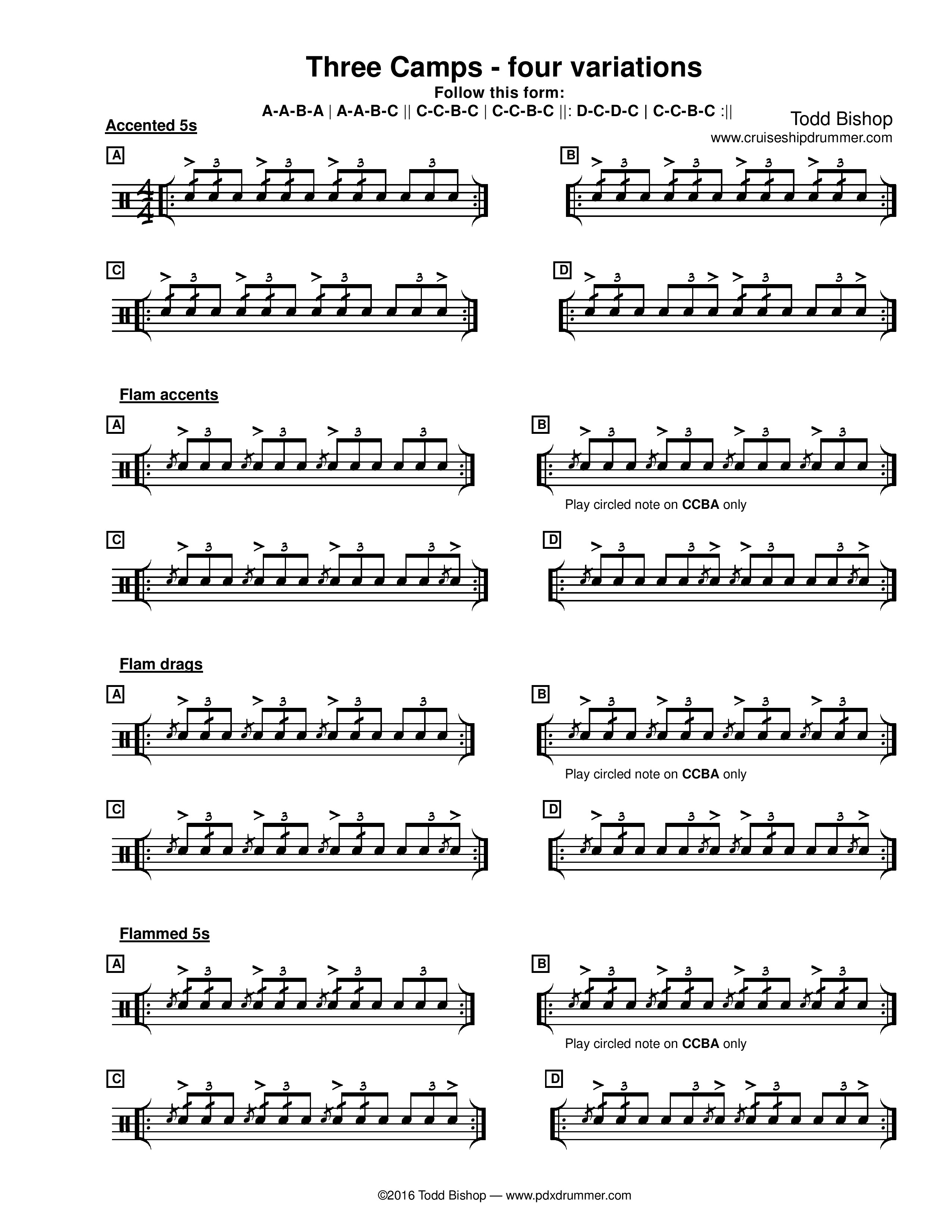
Four alternative ways of playing the rudimental piece Three Camps, that I'm practicing this week, accented 5 stroke rolls, flam accents, flam drags, and flammed 5s.  


Learn each measure individually, then play them in the form given at the top of the page. Chop out. 

Get the pdf

Tuesday, May 02, 2023

Transcription: Max comping

That's the theme of the week now: jazz comping. Here's Max Roach playing on the horn solos on A Little Sweet, from his record The Many Sides of Max. Each solo is 24 bars long, and the soloists are George Coleman, Booker Little, and Julian Priester. The transcription begins at 0:36, tempo is about 230. 

There's an element of sounding composed with Max— everything sounds like a deliberate statement. I noticed when transcribing Freedom Suite by Sonny Rollins that he often repeats whole phrases. It's very unusual— all drummers repeat stuff, with Max there's something non-organic about it. Like measures 19-20 and 31-32— there's no reason to for that specific sequence of things to repeat. I don't know how he arrived at that. It could be unconscious, or totally deliberate. 


The cymbal rhythm is mostly consistent, and he plays the bass drum all the way through, pretty loudly. There are some accents on it, probably more than I've indicated— I feel like I'm hearing him leaning on beat 4 often. I really didn't pay attention to the hihat— it's not loud on the recording. Maybe he dropped it out occasionally and I missed it, it's not consequential. 

There are a number of phrases that are worth practicing on their own— probably any two or four measures. A few that stood out are bars 11-12, 43-44, 49-52, 65-66, and 71-72. 

Also bars 1-4, or 2-3, or 3-4. He's doing a New Orleans kind of thing between the snare drum and bass drum, that I associate with Billy Higgins later on.

And bars 21-28, or 21-23, or 25-28, eliminating the SD on 1 of bar 25. 

Also noting that some of his longer ideas, where he's phrasing in 3/4 within the 4/4 of the tune, he begins them at the end of one soloist, through the beginning of the next soloist. That happens in measures 21-28— the double bar in the middle of that passage is where the soloists change. Also in bars 44-52. To me that's very unusual. 

Finally, analyzing it from the perspective of that comping formula we learned about the other day: you're not going to see anything like that— &s of 1/3 on the body of the phrase / & of 4 at the end of a phrase. What we see is that they will alternate: & of 3 will be followed by an & of 2, and vice versa. See measures 17-18, 33-34, 53-54. More often his ideas will be phrased in 3/4 time outright— see several of the suggested phrase above. 

Get the pdf

Monday, May 01, 2023

Groove o' the day: Billy Higgins - Mystery Song

Let's gooo, this is now a full-time Billy Higgins site. Here he is playing a New Orleans/Poinciana/Vernel Fournier kind of groove, on the Duke Ellington tune The Mystery Song, on Steve Lacy's record Evidence:


Swing the 8th notes, use a mallet on the toms. Pretty straightforward. 

Get the pdf