“A lot of drummers try to be futuristic and more modern, but they lose the groove and find themselves nebulous instead of in contact with what it really is.
So all of the interesting things that are happening, all of the intricate things that are happening in their percussive playing or music making, don't have the same significance because they lose the groove.”
- Reggie Workman, Modern Drummer, July 1981, piece by Scott K. Fish
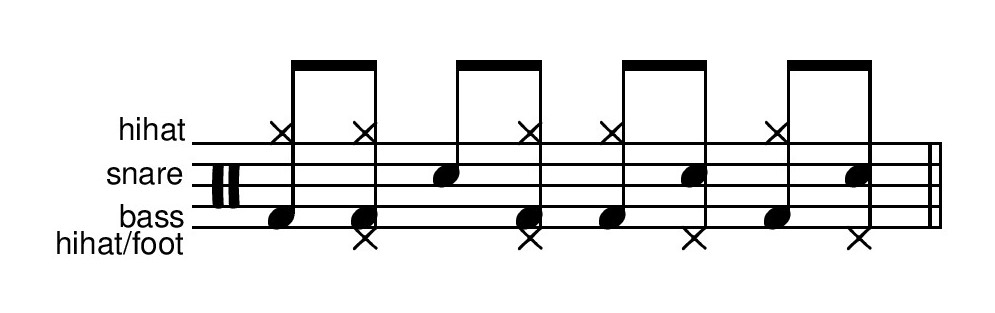
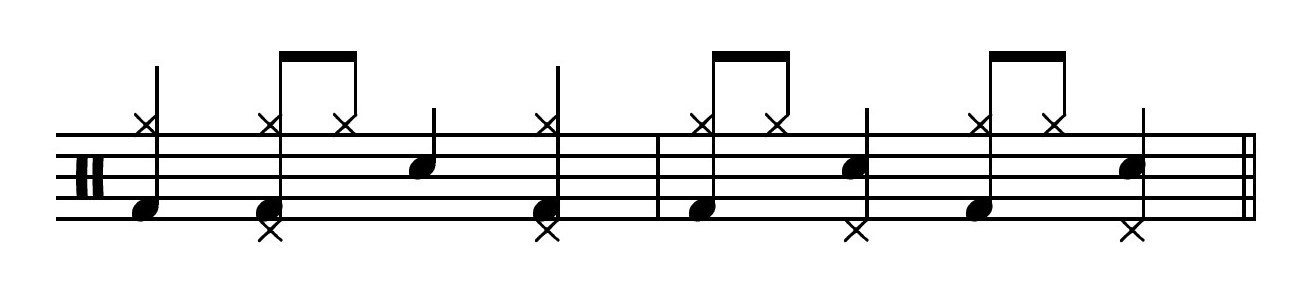
Extending this EZ fast rock / rock in 3 series, with quarter notes on the cymbal: here are some beats and ideas in 5, phrased 3+2. I wrote this series to illustrate the difference between 4, 3, and 5, using similar materials, for a younger student who asked about it.
Learn the beats, then combine them? That may be a more difficult problem than we're generally dealing with here— most of my students for whom this is intended will be preoccupied with staying oriented just in one measure of 5.
Ralph Humphrey, who had been undergoing cancer treatment, has entered hospice care. He's one of the first drummers I ever knew the name of, from Frank Zappa's album Apostrophé. I was about 7 years old, and my brother had the record. Later on a learned of his book Even In The Odds (he left a comment here on my review of it), and when I was looking for a school in LA, was considering studying with him at Cal State Northridge— ended up at USC. As a San Jose State alumni, he's definitely extended family— many of my teachers and peers also went there.
And Brazilian drummer Ivan Conti has passed away. Best known for playing with the fusion group Azymuth, bringing that beautiful Brazilian spirit to fusion, playing it with a lot more soul than is normally associated with it. I've transcribed a number of his things since I've been doing this site, learning about his playing is very worth it.
I'm noticing— online, and to a lesser degree with some students— a lot of people approaching the drums mainly in terms of drumming media. Books and videos, and the drumming concerns they promote, are the main things they think about.
Promoting that is a deliberate project with YouTubers. And people are comfortable with it, and bring that attitude to, for example, John Riley's excellent book, The Art of Bop Drumming; the book is 100% of their experience of jazz, and they make a doctrine out of it. There are other examples, I don't feel like thinking about it to list them.
Think of that manufactured laundry list of drumming concerns, and then put on a record, and listen to the whole thing:
That is what we're doing, that is the musical act, that is natural motivation.
The list of concerns just vanishes. You can't listen to that and be thinking what's his finger technique? Would that have been better if he played open handed? Was that a herta? Was he feathering the bass drum? The categories of things the Joe Blow YouTuber advertised are totally, obviously, made up and irrelevant.
That's what records are all about, forming an idea of what music is, what kind of musician we want to be, how we want to play the drums. There's actual joy, love, and art in it, which are ultimately the only things that can sustain you for decades of being a musician.
Now my Generation X self also believes that actual hard media are important— putting on a record, CD, or tape, and running it over and over— because changing the record takes some effort, and because you've been drawn into the world of the album. No shuffling, no skipping. You have the cover art sitting around the house, you don't have to go through an interface to read the liner notes and credits. It's tangible and immediate and it's part of your life.
The false abundance of the digital age has to go. You're one human, you cannot process infinite free music.
What you do is: be with one thing, now. And keep doing that. Pay the $4-18 for the record, pay it respect and form an attachment to it. That guides your progress as a musician, and is the foundation of an identity.
Minor tweak to an ordinary right hand lead Reed system, making an approach to playing jazz at fast tempos. I've probably written something like this before, I can't be bothered to check. This way has some stages so people can tailor it to their current level of development. Hopefully between the different systems I've shared, people will have some tactics for approaching this difficult area better than just brute force “play your bop stuff really, really fast.”
For the examples we'll use this rhythm from Syncopation, p. 34:
Play a straight 8th right hand lead interpretation— play the rhythm on the cymbal, with bass drum in unison, fill in the spaces with the left hand on the snare drum. Add hihat with the foot on the &s:
Then you can then double the last of any run of 8th note spaced notes on the cymbal:
Note that we're making the jazz time as a double time feel, implying this two measure phrase in a fast 4:
I recommend spending of time with just that, at increasing tempos, and not going straight for the following denser options. But from there you could double any single left hand notes (which is all of them, in this example):
From there you could fill in any remaining 16th notes— notice that the hands are doing a paradiddle diddle sticking here:
Here we're playing the RH doubles on the bass drum as well, and taking away the single notes:
Or you could take way the bass drum altogether. Try some different things.
I don't know how useful it would be to play the full page exercises this way. Not all the one line rhythms in Reed will work equally well as actual playing texture— consider them more as calisthenic drills than literal playing vocabulary. Actual tempos for the above could be 120-200, making implied tempos of 240-400 bpm.
Addendum to yesterday's Billy Higgins transcription— here's the Latin groove he plays on the A sections of the head on Moose the Mooche, from Joshua Redman's album Wish.
More or less— it takes a couple of measures to settle on it, and he moves his hands around a little bit. This appears to be the core groove:
Some uptempo trading 8s and 4s on Moose the Mooche, from an old favorite album, Wish by Joshua Redman, with Pat Metheny and Charlie Haden, and Billy Higgins on drums. I used to play along with this track a lot.
Tempo is a little over 300 bpm, and trading begins at 2:17:
Virtually all the activity here is with the hands— there is a little feathering the bass drum in half notes in the last 4. Maybe there's more than that, I didn't check. Distinction between accents/non-accents is not extreme, though notes marked as ghosted are definitely ghosted. Obviously there are paradiddle-type stickings happening on the tom tom activity.
Working on my EZ Fast Rock page, a younger student asked a question like what's the difference between playing in 3, 4, or 5? Well, here we go, some similar stuff written in 3/4.
I like this format— one page with a lot of easy patterns, that all together = pretty OK baseline vocabulary for a basic style.
Learn each measure, then combine measures in two measure phrases.





.jpg)
