Showing posts with label Page o' Coordination. Show all posts

Saturday, December 24, 2022

Page o' coordination: Airto's afro

Page o' coordination based on Airto's unique afro 12/8 groove played on the intro of Casa Forte, from Flora Purim's album Stories To Tell.

It's a good introductory groove for this style— the hands are mostly in unison, and the rhythm is easy to follow. The bell rhythm is only different from the normal short bell rhythm by one note, but it seems like a whole different thing, and it should be much easier to work out the coordination.


As always, work out the patterns, then drill them by doing some moves with the left hand

Get the pdf

Monday, December 12, 2022

Page o' coordination: hihat in the space

Here's a page based on this ongoing Elvin Jones transcription— I observed when he was playing time on the hihat, he would tend to close it before the beat. I also saw him doing that at a faster tempo, on Chasin' the Trane. And he often puts the hihat on the & of 1 in that Afro-waltz type feel. So let's work it out a little bit.    

Let's be clear that these are coordination patterns. Check out the transcriptions and recordings to see/hear how he actually does this— you don't want to go in and do this as an ongoing time feel. Though there's at least one kind of stock shuffle groove that does something like this


Swing the 8th notes, play the cymbal part on the hihat, observing the open sounds; also play it on the ride cymbal. Take care with articulating this distinctly from the normal hihat close on 2 and 4— doing it unthinkingly could mess with your time feel. 

Get the pdf

Saturday, December 03, 2022

Page o' coordination: Juju

I'm transcribing a little bit of Elvin Jones's playing on the Wayne Shorter tune Juju, which I originally did off the LP around 1988. It'll take some time to finish it, so here's a page developing the main groove from it— a version of the thing I've been calling an “Afro waltz.” Most people would probably say “Elvin waltz.”

Slightly different format from the usual POCs, exercises 1-10 build the particular groove Elvin played on the recording, and have specific drums assigned, including some changes to the bass drum rhythm. Exercises 11-18 have other left hand rhythms for basic fluency. 


Swing the 8th notes. Practice with and without the tie on the cymbal rhythm in the first measure. On exercises 11-18 you can do the stock left hand moves I use with these pages. 

Get the pdf

Here's the tune, it's a record you should know well:

Tuesday, May 10, 2022

Page o' coordination: quasi-samba - bass drum variations

More student stuff! Someone needed a Latin rhythm for a tune he's playing in a rehearsal combo, and this repeating quasi-samba pattern is what he came up with. So in the lesson we worked through some bass drum possibilities, so he'll have some options for developing the groove over the course of the tune. It's a jazz tune, so the rhythms do not need to be stylistically “correct”, they need to fit and adapt to what's going on with that particular arrangement. 


Repeat each pattern until it settles into a relaxed groove. Hihat can be played on beats 2/4, on all four beats, or on the &s. We discussed that you don't need to assemble a full-blown four limb part for a static groove like this— every change you make to it is a big deal. Adding hihat, taking it away, moving to a different cymbal, switching from rim clicks to hitting the drums normally, adding bass drum, adding slightly busier bass drum.  

Get the pdf

Monday, May 02, 2022

Afro 6 - advanced bass drum ideas/coordination

A page of patterns I'm playing around with, in an Afro 6 feel, that are difficult or unusual for varying reasons— either the bass drum is in unison with the left hand, or the actual rhythm is unusual. Use it as a companion to a similar page I wrote a couple of years ago, to develop some possibilities for soloing and blowing, with maybe more of an African vibe. 


Before even getting into this, you should develop line 1 as standalone groove. Vary the bass drum by playing it along with the cymbal, like on this page. The left hand part fills in the gaps in the cymbal rhythm— play it as rim clicks, or move it around the drums, varying the accents and articulations. Or do it funk style by accenting the snare on beat 3, and ghosting the rest. Add hihat however you like, on all four beats, or on beats 2/4. 

Get the pdf

Saturday, December 18, 2021

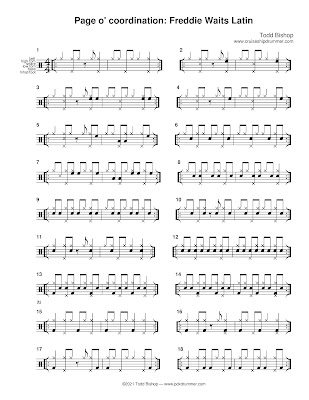
Page o' coordination: Freddie Waits Latin

Last week I picked up kind of a random live Freddie Hubbard CD from Music Millennium— I forget the title, it's in the car— with Freddie Waits on drums. I've been wanting to hear more of him. On a Latin tune Waits plays a bell rhythm from way back in my memory— I think I learned it in high school or early in college, and I don't know where I got it. I might have made it up, because it's not a real Latin rhythm, as far as I know. It's similar to the well known “Bossa clave” rhythm, so-called*, so maybe it's more quasi-Brazilian than quasi-Cuban. The bell part also is sort of a shuffle, in a cross rhythm.  

* - It's not clave. 

I phased it out of my playing after I borrowed/stole a Mozambique rhythm used by Portland drummer Ron Steen— that has been my go-to quasi Cuban rhythm ever since. But it's interesting enough to play around with a bit. It leans into an Elvin-style running dotted-quarter note feel, which the authentic clave based rhythms do not. 


Some patterns have a suggested voicing on the snare and toms, some do not. Play around with it, improvise your own moves, leave some LH notes out. Try the different bass drum rhythms along with the left hand rhythms.

Get the pdf

Wednesday, November 10, 2021

Page o' coordination: basic triplet texture in 5/4

Continuing this little series. You could warm up for this by just playing the original 4/4 page, repeating beat 1 at the end of each measure— effectively playing ||: 1-2-3-4-1 :||. Like we originally played it in 3/4 by just chopping off beat 4. That's kind of fun. 

But I wanted to place the bass drum differently— this page better suits what I want to do with 5/4: 


It's very straightforward. Just play them down, and begin improvising similar textures on your own. 5/4 is a peculiar time signature, and not easy to feel at all at first, so you should probably be counting your way through. See my old series Cracking 5/4 for some pointers on that, and try playing along with my corny Jesus Christ Superstar loop.    

Get the pdf

Monday, November 01, 2021

Page o' coordination: prep for subtractive method with Rumba bell

Continuing this subtractive thing using another common Latin bell rhythm, a Rumba rhythm, Guaguanco. There isn't typically a bell used in Guaguanco, but played on the drum set, it's the equivalent of the bell rhythm; if you want to be slightly less inauthentic, play it on a jamblock or shell of the drum or some kind of wood sound. I'm playing it mainly on the ride cymbal. I just want to play creatively in the kind of quasi-Latin stylings done by jazz musicians— and not be totally lost playing music that is actually clave-based.  


Before getting into it, it helps to think about the bell pattern a little bit. I found it helps to orient around the 2& in the first measure, and the 3& in the second measure. For me the rest of the pattern falls naturally if I just play the 2& and 3& in the right spot. 


Also note the three right hand doubles in a row from that 3& through the repeat: 


It's also a good idea to practice each measure individually before doing the full pattern. 

And once again, these two pages are very substantial by themselves. You could practice this system while reading out of Syncopation (pp. 4-5, 10-11, 30-45), or not. I think it's worthwhile. Playing the Mozambique bell part, I was able to do all of the one-line patterns easily; doing the longer exercises is going to take more practice. 

If you get into my Latin loops archive, there are several suitable loops at reasonable tempos— look for the ones labeled Rumba. 

Get the pdf

Saturday, October 30, 2021

Page o' coordination: basic triplet texture in 3/4

Same deal as the recent triplet texture in 4/4 page, done in 3/4. A simple linear triplet pattern with added bass drum variations. I already did this with a student, looking at the page in 4— we just ignored beat 4. Similar to the other thing we did recently putting Chapin in 5 by repeating beat 1 at the end of the measure. Both of them work surprisingly well. It's an easy way of adapting your normal jazz materials into other meters. 

Here I've rewritten the bass drum parts to put them in a more logical order for 3/4: 


Play them through, and have fun. This is an easy way to get novice students into an Elvin Jones type of texture. Try playing them along with my All Blues loop when you're ready. 

Get the pdf

Wednesday, September 29, 2021

Page o' coodination: prep for subtractive method with Mozambique bell

I wrote this for my own use— I was attempting to do that recent subtractive Reed method with the more complex Mozambique bell rhythm, and it will go much faster to see the warm up patterns written out. As I pointed out, that BSSB-SBBS rhythm sketches out a tresillo rhythm in the bass drum, and suggests the 2 side of clave in the snare drum, which makes it an attractive idea to develop for a Latin context. 


There are a lot of patterns, so we're getting quite a bit done even if we never get around to applying this method on the fly reading out of Syncopation.  

Get the pdf

Tuesday, September 14, 2021

Page o' coordination: yet another Elvin 5/4

Here's a page o' coordination based on Elvin Jones's playing on Lazy Afternoon, from Grant Green's album Street of Dreams. It's a medium slow 5/4— the tempo is about 109. He plays the ostinato below fairly regularly, with many small variations. I've given the approximate default thing he plays on the snare drum, and then my usual kind of independence exercises with the ostinato:


Try my dopey old Jesus Christ Superstar loop with this one. Once you learn the patterns, move your left hand around the drums— improvise the moves, or use this set of stock moves I do with all of these. Add the circled bass drum note in the ostinato if you feel like it. 

See my other Elvin-like POCs, based on his playing on Your Lady (adapted into 5/4), a variation on that, and on That 5/4 Bag

Get the pdf

Tuesday, June 29, 2021

Page o' coordination: pseudo-Latin in 7 - 01

A page of independence patterns for a quasi-Latin groove in 7/4. The cymbal part is based on a Mozambique rhythm, and there the similarity to any real Latin music ends. This is not a style, that I'm aware of, but things like this turn up in modern music. The idea is just to learn how to play in 7 better by doing something familiar. Hopefully you can already play the Mozambique rhythm before doing this. 


The bass drum and hihat parts are pretty minimal, and you can omit them at first if you want. You can also try them without the circled snare drum notes. Learn the page, then practice it using all of my stock left hand moves.   

Get the pdf

Sunday, May 16, 2021

Page o' coordination: Jimmy Cobb Afro

Page o' coordination based on Jimmy Cobb's playing on the tune Not A Tear, played by Wynton Kelly. The main groove Cobb plays on this tune is actually identical to the groove from Andrew Hill's MC, played by Idris Muhammad— which I misattributed to Freddie Waits. It's a good groove to have at your disposal for situations requiring an easy to follow version of this feel. Here we'll look at a variation Cobb frequently plays on that tune.  

That POC at the link above, plus today's POC, plus this warm up page, and perhaps this one, make a pretty fair introduction to this area of playing— for mastering the coordination, at least. Scroll through my Afro 6 labeled posts, you're bound to find others, and many serious challenges as well. 


My suggested method is to learn the whole page, then drill it using some set left hand moves around the drums.  

Get the pdf

Here's the recording— the Afro groove begins at around 2:00:

Monday, February 08, 2021

Page o' coordination: grocery store hemiola - 01

So-called because I found myself unconsciously tapping this out in the grocery store parking lot while waiting for them to bring out my groceries. 

...incidentally, for the sake of limiting your exposure to COVID-19, I highly recommend the curb side service when getting your groceries, if your store offers it. Right now the Fred Meyer where I get my groceries— a Kroger market— offers the service free of charge. 

So I was tapping pattern 1 with my RH/LF while waiting for the guy to bring out my stuff, and for fun I wrote up a PAGE O' COORDINATION for it. 


There are independent parts for snare drum and bass drum, but you can/should play them all on either drum. Use the stock tom moves when playing these with your left hand. 

Get the pdf

Wednesday, December 30, 2020

Page o' coordination: feet in the gap

Another little item inspired by the ongoing Chasin' the Trane transcription— in which Elvin Jones does this a lot. Here we've got both feet in unison, played on the &s of 1 and 3, in the space in the cymbal rhythm. I've never practiced that exact move, so it's a little awkward. What's cool about dumb easy things you never practiced that are a little awkward is that you can work on them briefly and your body actually learns something new.   


The whole idea is to refine the timing of the feet unison on the & of 1/3— don't crowd the cymbal hits on 2/4. Don't play this page if you're not going to be really careful about that. It's probably a good idea to alternate one or two measures of exercise with one or two measures of regular ad lib jazz time. 

Do this together with the other recent page o' coordination with the repeating RLRR sticking, and add the left foot in unison with the L. 

Get the pdf

Tuesday, December 22, 2020

Page o' coordination: jazz / RLRR

Working on this Elvin project the last couple of days, I noticed that, similar to Max Roach on another recording, he plays the snare drum in the gap in the cymbal rhythm a lot, for a sticking of: RLRR RLRR. It's almost like a foundation pattern, a home base. This a page using that pattern, adding some basic things to it.  

I already wrote this page, more or less, last year, but this version is easier. I'll use this with a few of my novice jazz students. I really like teaching the same basic thing several different ways. Like if we just teach jazz comping rhythms with Chapin, people start thinking jazz = one-measure left hand independence patterns vs. a static cymbal rhythm. If we only do Syncopation, maybe they won't have all finer points of the coordination worked out. You never know what idea is going to click for what person, so they really understand what they're doing, and are able to use it creatively. 


Swing the 8th notes. Treat the complete exercise patterns as extensions of the base RLRR pattern— they're places to go from the base pattern. Add the hihat on beats 2 and 4, or— and this is another thing I notice Elvin doing a lot— on the & of 1 / & of 3, in unison with the snare drum. Actually Elvin does it most often in unison with the bass drum, but that'll have to wait for another page of stuff.

Also see my other pages of sticking patterns for jazz. Also check out a post from a long time ago, The Kenny Note, in which I noticed the Kenny Clarke sure does play that comping rhythm a lot.  

Thursday, September 03, 2020

Roy Haynes waltz lesson - practice suggestions

So, I wrote that Roy Haynes waltz lesson in about ten minutes— I just listened to the tune and picked out the most obvious possible ways to cop the basic thing he's doing there. And since I titled it WORLD'S SHORTEST ROY HAYNES WALTZ LESSON, one could get the impression that it's something you can learn to do quickly. Not so! Just playing through the things on the page takes some time, then you have to learn to improvise a texture from those ideas. When I sit down with something like that I inevitably do a lot more with each thing.

On this page we'll look at the first pattern for that lesson, and run through some of the things I play when I practice it. I do as many of these as I can on the fly, but a few of them I would need to see written down. Not all of these are suited for the tempo on the Chick Corea recording— not right away, anyway.


I would also play the bass drum one note per measure, on every single note of the cymbal rhythm, especially if trying to cop the Roy thing. There's only so much you can put on one page. You can add the hihat on beat 2 and/or the bass drum on beat 1 wherever you like. Swing the 8th notes.

Continue thusly with the other sticking patterns on the lesson page. I hope everybody knows you have to find your own groove with these things— you speed through some things, and work longer on the ones that are harder for you, or that have a lot of creative and musical possibilities for you. That goes for everything else on the site and everything else in drumming. No written materials anywhere are a linear map for getting good. 

Get the pdf

Tuesday, August 18, 2020

Chapin exercises in 5

This is what you do during quarantine when it's too hot to practice or doing anything else serious: capture jpegs of a well known drum book, open it up in Paint.net, and cut it up to put it in a new time signature.

We talked about this a few days ago in the Easiest 5/4 post. This is the first part of Jim Chapin's Advanced Techniques for the Modern Drummer, with the first beat of each pattern pasted onto the end to turn the 4/4 patterns into 5/4. I could have just written this up in Finale, but this is more fun.


Hihat goes on 2 and 4, add a bass drum on 1. After doing this you should get the formula, and be able to work through the rest of ATFTMD in 5 without seeing it printed out. Easy variations you can do to get a little more vocabulary mileage out of this might be:

• On beat 5 just play a quarter note on the cymbal, or on the snare and cymbal with both hands in unison.
• Leave out any snare drum in unison with the bass drum on 1.

I'll write up a summary of some other possible variations soon. I find them to be an important part of the process of learning to play in 5. 

Get the pdf

Saturday, August 01, 2020

Page o' coordination: Freddie Waits Afro

UPDATE: A student brought it to my attention that according to Wikipedia, Idris Muhammad is the drummer on this track. Which surprises me, but there you go.

A combination groove o' the day and page o' coordination here. On MC by Andrew Hill, from his album Grass Roots, Freddie Waits plays a Afro feel with a simplified cymbal rhythm that is similar to the “Afro Blues” rhythm (my phrase) I wrote about a few years ago. It's a good introductory groove for this type of thing, and, with a stronger dotted-quarter note pulse, it's probably good if you're playing with a weak rhythm section. Or, what the hell, if you just want a cleaner groove with a stronger main pulse.

On the top line are the cymbal/feet ostinato, and the complete groove as Waits played it on the record, and the rest of it is the practice patterns:


Learn the page, then drill it while doing my left hand moves.

Get the pdf

Wednesday, April 08, 2020

Page o' coordination: Olé - 01

A Portland jazz educator asked me about what Elvin Jones was doing on the tune Olé, by John Coltrane, so I wrote this up. He plays a few different major patterns, and this might be the easiest one— and I've simplified it a little bit.


There are a couple of different options with the bass drum; you can eliminate the circled note, and/or add bass drum on 2 or the & of 2 in the first measure. Or, hell, you could eliminate the bass drum altogether while you get the hands happening. You could also pencil in a hihat on 3 in the second measure if you want. He often plays it on 2 in the first measure and 2 and 3 in the second measure.

Do my stock left hand moves. With this Elvin type thing, maybe play the snare drum hits as rim clicks.

Get the pdf