Showing posts sorted by relevance for query reed. Sort by date Show all posts

Sunday, August 15, 2021

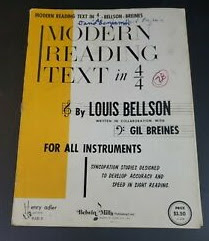
Louis Bellson reading text in 4/4

 Here are CRUISE SHIP DRUMMER! we spend a lot of time with the book Syncopation, and not so much with its more expansive, more serious-seeming companion, Louis Bellson's Modern Reading Text in 4/4. I use Reed a lot, I never use Bellson— both in my practicing and my teaching. I've owned Bellson for many years, and have tried using it, but it never stays on my stand very long. Let's take a look at what's in it and figure out why.  

The book is comprised of full-page and half-page composed exercises covering all the variations on a single rhythm idea, or summarizing several rhythm ideas. In Reed, by contrast, the individual rhythm variations are written out on one full four-measure line of music; the longer exercises are the rhythm summaries or composed exercises. 

You can play Bellson the same way you do Reed, playing each measure of the exercise several times, and then playing the exercise straight through, but I prefer the one line format in Reed, especially for teaching students of different ages and abilities. The graphical representation of the four measure phrase is helpful, and it encourages better reading habits— the student can move his eye along the line of music and then repeat back to the beginning of the line, or look ahead to the next line and continue to the next exercise. That's normal reading; looking at one measure in a line of music and repeating it over and over is not so normal. 

Looking at the individual parts of Bellson: 

Whither quarter notes
There is no dedicated section dealing with quarter notes and longer rhythms. I think that's a mistake. Fluency with quarter notes is kind of an overlooked area, and I would have liked some studies including whole notes, half notes, and dotted half notes for use at fast tempos.  


Pages 4-8 - Quarter notes, 8th notes, 8th rests

These are good pages, and a little more in depth than the equivalent pages in Reed— includes many rhythms only written with syncopated-style notation in Reed, which I don't really need.


Pp. 9-11 - Introducing the tie

Ties are important, but to me these pages aren't well balanced for drumming practice. The Reed p. 33 summary of 8th rest/tie/syncopated summary illustrates the concept more quickly and clearly. 


Pp. 12-13

Introduce some 16th note and triplet rhythms, that are rather disruptive to doing systematic drumming practice. We get that stuff from snare drum books— Delecluse, Peters Podemski. I don't really need it for developing drum set reading, and drum set practice systems. 


Pp. 14-25 - Syncopation

The first two pages are summaries of how syncopated notation works, but again I think p. 33 of Syncopation is a better summary of this. The ten syncopation exercises on pp. 25 are fine, I just never use them. They include some non-standard notation, like writing three 8th rests in a row, or putting a syncopated quarter rest between two 8th notes, or tying two 8th notes where the first one falls on the beat, or violating the “imaginary barline” between beats 2 and 3. Yes, reading those probably helps my reading, but learning to read bad notation is not at all my primary purpose in using these books. 


Pp. 26-39 - 16th notes and rests, tied 16ths

These pages cover a large gap in Reed, and should be very useful, but I find them quite tedious. Full pages dealing with a single type of 16th note rhythm, written as many different ways as possible. This is


where the book becomes increasingly focused on creating reading problems. It sacrifices its usefulness as an everyday practice book for the sake of forcing you to deal with exceptional reading situations. Like there's one measure with nine 16th rests. It's exhausting to look at.  

And for all that, it totally ignores some common ways these rhythms are written—the e& page, for example, always writes that rhythm with all 16th notes or 16th rests, or tied 16ths. Never as is it is commonly seen in drumming literature, 16th rest-16th note-8th note.

This section is also not as useful as it might be because on drumset, in real life, I don't have to read many 16th notes. When I need to practice a four note subdivision on the drum set, I practice Reed in 2/2. I teach reading 16th notes with a combination of snare drum and funk books. 


Pp. 40-46 - Ten syncopated exercises with 16th notes
These are not terrible, I just have little use for them. Each exercise is so varied they're mainly only good for comping/independence practice— to do the other interesting and useful things involving filling in the gaps in the written rhythm, we would have to devise some new methods. Maybe that would be worthwhile, I just haven't felt the need.   

P. 47-60 - Eighth note triplets
All about triplets and triplet partials using rests and ties. This seemingly fills a large gap in Syncopation. But we do play a lot of triplets through the usual Reed methods, they're just implied, and not written out. I don't find it to be a problem, from a reading perspective, because, again, I don't often have to read them in music for drum set. 

And once again, this section quickly devolves into graduate-level reading puzzles. At a certain point, this focus on fragmentation begins to detract from the fundamental concept. It's not that ambitious students shouldn't be able to read it; that focus just detracts from the book's day to day usefulness.  


Pp. 61-64 - Introducing the quarter note triplet

Another valuable subject missing from Reed... that instantly descends into flyshit-reading hell. Same goes for the half note triplet section after it. 


Pp. 66-67 - Syncopation with triplets

Not terrible, but random. Put a permanent book mark on these pages, or tear out all the intervening pages. Not worth the effort to me. 


Pp. 68-81 - Fourteen exercises

Regular syncopation exercises with 16th notes and triplets included. These are reasonable, decent reading exercises, but again, the variety of rhythms makes them difficult to use for daily drumming practice— beyond just using them as complicated independence rhythms. 


Pp. 82-85 - 16th note triplets and 32nd notes

Not terrible, but you would have to devise a use for them on the drum set. Or just play them on the snare drum. Delecluse and Cirone are full of stuff like this. I've never seen anything like this when reading for drum set. 


Pp. 86-87 - Introducing double time

This is useful; we get some common syncopated rhythms, together with their double-time equivalent. But once again, the authors can't resist messing with us by writing the rhythms in a bad, difficult to read style. How about if we learn THE CONCEPT, then you can teach us all the wrong ways it might be written?


Conclusion
So this is only partly a rhythm book— it's at least 50% a reading-bad-notation book. I don't know who needs to master performing this level of reading in their day to day professional life— LA studio musicians? Classical musicians? Math-genre people? I think a lot of this is better covered with regular literature written or transcribed for the user's actual instrument. 

At some point with this crap, you're just teaching people bad notation style. OK, we want to be prepared to read “anything”, but here bad notation is way over-represented, and the actual good notation is just part of the undifferentiated notation-bomb debris field. So some composition student works through this thing and thinks “hell yes, I can write a quarter note on the & of 2 any time I want, why not.”

Reed has it's limitations, but as a day to day practice volume for drummers of all levels, it's vastly superior to this— that just isn't what Bellson's Reading Text is. And you can fill in all the major gaps in Reed by just finding a copy of Chuck Kerrigan's out of print Syncopated Rhythms for the Contemporary Drummer. Those two books form a drummer's complete core rhythm vocabulary, to which, having mastered it, you can add whatever other oddball things you want. 


By the way

Bellson's other reading book, Odd Time Reading Text, is even worse. Maybe 15-20 of its 130 pages are useful— which may be good enough reason to buy it. 

UPDATE A FEW DAYS LATER: Compelled to force myself into an embarrassed retraction of this whole piece, by finding a real invaluable drumming purpose for the book— so I'm practicing out of it more than I normally would. So far I'm a little more annoyed than I already was. 

For example, if I know ahead of time that all the 16th notes on p. 30 are on the e&, it kind of defeats the purpose of writing it all kinds of crazy ways to trip me up. You're not teaching me to read crazy notation, you're teaching me to ignore the notation based on prior information. Is that the intended lesson? I don't think so. 

And the formula of repeating a measure with the rhythm notated differently, or repeating the same rhythm except with 8th notes substituted for quarter notes— it gets tiresome. Mix it up, let me pretend I'm playing a piece. 

Friday, April 21, 2017

What's the point?

Yeahhh, you probably don't
need to bother with this one.*

* - Not a terrible book, actually.
Since we here at CRUISE SHIP DRUMMER! dump countless pages of quality practice materials onto the internet annually, and with the unprecedented quantity of drum stuff generally available to practice— some authors hell bent on dominating the rest of your natural life practicing their stuff— it's a good idea to talk about what we're supposed to do with all that. There's obviously too much out there to “master” in a lifetime, and seemingly every nook and cranny of drumming has been covered, so what's the point? Why continue buying books? Why write more?

First, realize that just because you have a lot of drumming books, doesn't mean you have to blaze on every single thing in them, or else you're a failure. We don't have libraries because we're going to memorize everything in them and then burn them down; we have them so they're available when you need something, to give you choices of what to focus on.

Let me put this as politely as I can: not every drum book doesn't suck. A lot of books from my formative years were mainly about some guy's fascination with writing down “hip”/“funky” drum patterns (ahem see any number of 70s/80s funk/fusion books). Or they use archaic notation and are way too hard to read (kof  Realistic Rock / Moeller Book). Some of them are sub-par rehashes of standard material better presented elsewhere (koooff many Mel Bay titles). There are genre books that are now hopelessly out of date (see that early 80s rap drumming book). Most pre-80s “Latin” books are completely inept, with the authors having no idea of how to introduce you to those musics (sorry Ted Reed, that book doesn't make it).

Currently a lot of books seem to think you're stupid as well as vision impaired (kofkofkoooff hack argh see any Drumeo/Drumming System-related pdf). I've seen a few recent books with a high internet profile, which are largely dedicated to a very laborious rehashing of things covered in Chaffee, New Breed, flipping Stick Control, and other standard books. Most of those repel me from practicing them— they refuse to stay on my music stand.

With all of that off the table, among the x-hundred pages remaining, things you actually would want to practice, there often just aren't that many pages dedicated to any one particular subject. Or even if there are, each presentation of an area of drumming will be a little different, and will be conducive to practicing certain ways, and resistant to practicing other ways. One page may be way too difficult for you to use this year, but it will open your eyes to a certain way of thinking, and you'll find a way to work on that using something else in your library— and maybe you'll be ready for that hard page in 1 or 5 or 10 years. And sometimes you just want to vary the terrain.

Listen: I'm of the opinion that you really only need one book, which costs about $7. You can make a Reed interpretation to practice virtually anything, and that's usually the best way to go, if possible. But Syncopation doesn't have everything in it, and some items are boringly presented. Or just because of the nature of the writing, Reed exercises may be ill-suited to doing certain things with them. There are also some things you'll want to practice that it would be counter-productively difficult to try to do with Reed. That's the reason for the page o' coordination series. The funk control series consists of nothing but things you can do with Reed, except it would be very difficult to practice that way out of Reed. And the sameness of the terrain can get to be limiting. Sometimes you need to see something written a different way to realize that you can make a Reed thing out of it.

I keep writing materials because a) I need them for my practicing or teaching, b) they're actually not available elsewhere, c) they're not available elsewhere in precisely the form I want, d)  rarely, they're available elsewhere, but I just want to have my own equivalent. I make transcriptions for my own ear training and to increase my knowledge of what people play, and how— for me those are truly not about the end result of a written-down page of stuff. In buying books, I consider the $10-25 to be (reasonably!) well-spent even if I only learn ok, that sucked— let's not do it that way.

Buying, owning, and using drum books is not just a simplistic linear transaction of I bought this; I must master the whole thing to Buddy Rich level or I suck. Instead consider a book to be well-used if a) you practiced a few pages out of it a lot, b) it helped you increase your drumming intelligence a little bit, c) you see there are some things in it you'll actually want to practice for years to come— which you can now tell because, through exposure, you have learned to be discriminating about what you practice.

After reading this, you'll probably want to re-read this old post on how much to practice something.

Thursday, April 01, 2021

Youtubed: practicing Syncopation

I'm feeling a little irked at the existence of YouTube drumming videos today, so let's do a search of a subject near and dear to me, practicing the book Progressive Steps to Syncopation, and see what the YouTube folk have to say about it, and I'll write my thoughts about them. I've been wondering about this; the Reed-associated methods are the professional system for becoming a reading, improvising professional drummer, yet very few people on the web talk about them. And the few that do, don't seem to grasp their full implications. 

I'll talk about the first videos that come up, in order. I'll list but not imbed any I just can't take. For example, the first one: an Expert Village thing entitled Syncopation for Drums : Drum Techniques— but every Expert Village video absolutely sucks going in. So I'm skipping that one. Or number 2: 15 Famous Syncopated Rock Grooves (That Inspire Creativity), a drum cover video in the guise of a lesson. I'm sorry, I cannot look at a clean young guy rocking out for the camera— all of these guys look that same to me. God love him, best of luck, I know he's going to get a million views, I just can't. 


So, the actual videos: 


Bruce Becker “Syncopation” Lesson Series 01: Left Hand Separation
Four minute video, obviously a great teacher, great drummer. Here one pattern is covered, briefly, with a whole lot of side comments. Hopefully he gets more in depth in the other videos.  

I don't dig using the word “separation.” It's not separation, it's coordination— the limbs are both plainly attached to the same human torso. If not, something is drastically wrong. Coordination is simply hands/feet playing opposite each other, and in unison with each other, to make a new, combined rhythm. Words matter, and words like separation and independence communicate a false concept of drumming coordination— the reality of which is we have a single controlling entity, the drummer, coordinating different body parts to create a drumming performance. 

I think a difficulty with prestige teachers like Becker, is that you get the impression that he has all the answers, and that they are the correct answers for everyone. So your study stops becoming a search, and starts becoming about how well are you doing what he says. But if you're into Mickey Roker, and a guy isn't reflecting any of that in his presentation, you may need to look elsewhere for those qualities. For me the exploration is more important than having this level of correct answer Becker gives. The answers you come up with yourself through seriously studying and performing music, will be at least correct enough for you to play well. 

It would be dumb to ignore information, and Becker has plenty. But it's one man's answer, which is not even directed at you personally— it's a video made for a general audience to demonstrate and share his general expertise, it's not a lesson plan for your development as a performer and artist.    


How to use Ted Reed’s Syncopation - Episode #1 jazz basics
Not a jazz drummer, but the verbal explanations are pretty solid. Strange cymbal technique, like a lot of these guys— they copied a video really hard, and took it to the next, wrong level. You get the feeling he did some studying and made the video, and luckily he basically studied the right stuff. Ends with some BS playing the ride cymbal with the left hand. No, no, no. But basically solid otherwise. It is not your imagination, on the demo starting at 2:30, he plays straight 8th and swing rhythms exactly the same— he swings them both. 


I play Ted Reed's "Syncopation" for 3 hours straight
Rock drummer plays Reed for 3 hours. Starts with a not great explanation of a complicated four limb triplet system. Weird mix, loud snare drum, everything else too quiet. I actually don't mind his cymbal technique. I could never do this— just flatly drill patterns for hours and hours. I need to practice like I'm playing something. It's not a question of  “optimal practice techniques”, that's just how I live. 


Syncopated Funk Groove I Drum Lesson
A Mike Johnston video, and I just. Can't. Do it. This is everything that is wrong with videos. Teaching a single hip(?) groove— the essence of hack teaching— that bull sh*t Drumeo manuscript, with one measure stretched across the whole screen, like that makes it easier to read. I don't need to you wish me an amazing day, I don't want to see your dog.

I'm not linking to this— I'm sure he's a lovely man— I mean obviously, listen to him, his loveliness unavoidable, even as you thought you signed on to learn something about the drums. But I can't. Search the video if you want to see it. 


Mel Brown Beat Syncopation Exercise
Here we go, the GREAT Mel Brown— Motown drummer, Diana Ross's drummer for many years, winner of a national Playboy Jazz award, student of Philly Joe Jones. And he taught my older brother. Catching his quintet at The Hobbit in Portland was one of the performance highlights of my college years. A GREAT drummer, band leader, and teacher.

He goes over all of the major basic jazz systems used with Reed, and one funk thing I've never done(!!!). Take the structure of this lesson seriously, everything about this is 100% correct and informative, right down to the short pants, and the cymbal that is pingier than you or I would like. If there's anything “wrong” with it, it's only because that thing doesn't matter.  


Using Ted Reed's "Syncopation" for Drumming Independence

Demonstrations of some basic methods on an electric set. They're not technically flawless, but so what. He does something close to my(""?) cut time funk thing. This is actually a reasonable video, even if it's not exactly dripping with jazz cred— real or fraudulent— so you're not going to take it over-seriously— it's just a demonstration of playing the notes and for that it's good. I like that he just demonstrates and doesn't talk.  


12 Ways to Use Reed's Syncopation - Part 1
Good teacher, nice clear way of explaining the premise. On topic the whole time. I don't need to hear about somebody's day, or listen to them butter me up with a lot of bro crap. Not exactly a real sophisticated jazz touch, but it seems more designed to demonstrate a feeling to her students. I prefer this to the hyper navel gazing technocratic style of the big video accounts. She shows you the thing, and a few things to try with it, and a few little special touches. And then you get to figure out where to go with it yourself. Teachers aren't supposed to be the last word on everything, they're supposed to show you how to something, and inspire you a little bit to go and do something with it. 


Syncopation: Expert Mode - Drum Lesson

Here we go. Why do people have to be so FULL OF IT. I understand that people put themselves under a lot of pressure to be on and to be appealing. By the time he gets to explaining the musical part I'm bored, I'm done, spent. Demonstrates some weird systems for practicing Reed, I don't have any use for any of them. This project, this playing of the drums, is not just about thinking up hard stuff. If we're going to do hard stuff, there's got to be a reason.  


Helpful Jazz Exercises for Drummers!

Good video, that is actually worth its 18 minute duration, and some further analysis to get the more advanced things he's talking about. The exercises he calls right hand lead and right foot lead are really important. A little bit of that macho L.A. touch on the drums with the hickory 5A sticks, that reminds me of Tom Brechtlein— that doesn't really fly as a default volume unless you're playing with fusion musicians. That's a minor quibble, it's an excellent video, and he's obviously a knowledgeable teacher and an excellent drummer. 


Tuesday, February 11, 2020

NOW AVAILABLE: 2019 Book of the Blog

OK, the 2019 CRUISE SHIP DRUMMER! Book of the Blog is now available for purchase.

This handsome 131 page volume includes all of the downloadable materials, transcriptions, and practice methods posted on the site in 2019.

The major subjects include:
• Hemiola Funk Series
• Max Roach quasi-rubadub pages
• Various harmonic coordination-based methods
• Multiple ways of playing Three Camps
• Special syncopation exercises
• A number of EZ pages and methods suitable for players of all levels
• 17 quality, playable jazz transcriptions
• A lot more!

Order today!


See the complete table of contents after the break:

Saturday, February 19, 2011

Best books: Like Syncopation

For many years Progressive Steps to Syncopation for the Modern Drummer (better known as just "Syncopation") by Ted Reed was virtually the only drum book I used. As I alluded to in the Joe Cusatis book post, I'm a big advocate of the interpreting-a-melody-line approach to practice, for which Syncopation is basically the Bible. Or Das Kapital, Origin of Species, whatever you like. It does have its limitations, which caused me to look into sources for similar materials. Here is a survey from my library:

Modern Reading Text in 4/4 by Louis Bellson. A classic in its own right. I find the majority of it a little too difficult for daily use- either Bellson is going way outside what is conventional in order to challenge the user, or maybe he is including things more likely to be encountered by horns. I use it primarily for its "10 Syncopated Exercises", which are long exercises similar to the ones in Reed. I haven't devised much in the way of practice methods adapted to the strengths of this book.

Odd Time Reading Text by Louis Bellson and Gil Breines. A thick book dealing with a wide variety of odd meters. There are several pages suitable for Syncopation-type applications, and quite a few more involving triplets and 16ths. Much of it is extremely difficult, in changing or */16 meters, which are frankly of limited value to me.

The Rhythm Book
by Martin Bradfield. Bradfield is a teacher in Pennsylvania who has self-published this book and two accompanying volumes of interpretive methods. Covers roughly the same territory as Syncopation, but with a number of rhythms Reed left out. Maybe the best companion volume of these, and a great value. Highly recommended.

Sunday, November 02, 2014

A Reed method for 16th notes in jazz — reading the quarter note sections

Over the course of a few posts I'll break down my method for developing jazz comping with 16th notes, using Syncopation by Ted Reed. 16th notes are used a lot in jazz, and drummers neglecting them can lead to fairly one-dimensional playing. In jazz this rhythm needs to be legato; if you articulate your 16ths the way you do in other kinds of music, they will sound quite bad. Play them the way the horn does on Confirmation:


First we'll look at some things you can do with the quarter note sections of Reed. We'll be ignoring the written bass drum part— the stems-down part— so any of the three two-page quarter note lessons will do. We will play the ride pattern with a dotted-8th/16th rhythm; again, don't play it too staccato. Try to make it flow. It looks funny when you see it written; this used to be a standard way to write and play the pattern, but you don't see it much any more:


The first two interpretations are straightforward: play the above time pattern along with the written melody line (the stems-up part in Reed) on the bass drum, while filling in a couple of different 16th note rhythms on the snare drum. For the examples, we'll use this written exercise in Reed:


In the book that's one measure of page 4 (Lesson One, in the new edition), line 7. Reading that exercise without playing the left hand, the time feel plus our bass drum part would look like this:


First, fill in the &-as on with the snare:


Then fill in the es and as:


Much more after the break:

Sunday, September 22, 2013

Good reading

Ignore the model's bad posture, tucked-in
muscle shirt, and Bay City Rollers
hairdo, and buy the book. 
If you've worked with Ted Reed's Syncopation in any serious way you've probably sensed that it has a few limitations. It's also such a central text— you can and should do nearly everything with it— that you can get to the point where you feel you've worked its raw material to death, if not its possibilities. The style of notation can be a little formulaic, and there are a few subjects that aren't given the famous page 37 treatment: 16th notes, triplets, and any meter other than 4/4, for starters.

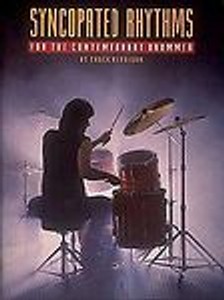
A good supplement, then, is Syncopated Rhythms for the Contemporary Drummer, by Chuck Kerrigan. It's 101 pages long, written in a similar style to the middle part (about pp. 29-44) of Syncopation, and has sections dealing with quarter notes, 8th notes, triplets, and 16th notes. It's mostly in 4/4, but there are also exercises in 3/4 and 5/4. Exercises are one, 12, 16, and 32 measures long. One-measure ideas are presented in four-measure phrases, with varied notation and accenting:


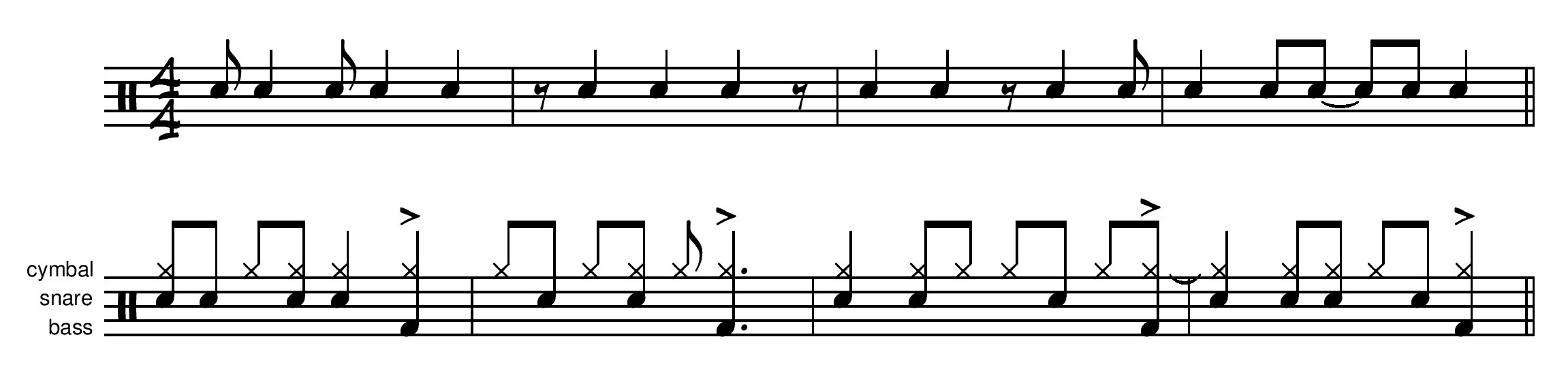
This varied way of writing the same basic rhythm is very helpful— it's not the same rhythm, actually, because the lengths of the notes are different; but the notes all begin in the same places from measure to measure— so the exercises read more like a real piece of music than do those in Reed, and gets you (or your students) thinking about how to handle variably long and short notes. A similar thing is done in Louis Bellson's Reading Text in 4/4, another popular Reed alternative, but the notation in that book is so far out that it is, for me, impractical— you're not likely to see rhythms written the way they often are in Bellson, and if you did, they would be considered extremely poor practice on the part of the copyist. Kerrigan offers a nice, realistic middle ground.

You can see that he includes written accents, which are not present in Syncopation— I haven't incorporated them into any of my own methods, but they add another level of possibility to the exercises.

The triplet section will be welcome to a lot of people, as drummers seem to be getting serious about dealing with triplet partials in a systematic way. In Reed, the middle note of the triplet is purely incidental— it is only present with the rest of the triplet, or as an un-notated filler note. Which is actually the correct place for it; it's not normally used in jazz, except along with the rest of the triplet, or as part of a quarter note or half note triplet, or as a “late” note— an effect. But now drummers like Ari Hoenig* are making it a regular part of the language, and Kerrigan's exercises will help develop that. It's more a native thing to African and Afro-Cuban music, which is how I use them— along with the Afro 6/8 bell pattern, for example.

Likewise, people working a lot with The New Breed, or who are just more accustomed to thinking in terms of 16th notes, will appreciate the 16th note section.

In the Reed tradition, Kerrigan includes a simplified bass drum part, which will likely be ignored by everyone, the same as it is with Reed. He has also added a hihat part, with notes in parenthesis indicating optional notes, or silent notes “played” with the heel of the foot when playing the hihat with a stepped, heel-toe type of technique.

Self-teachers will also appreciate the included summary of interpretive methods— sixteen of them—  for applying the rhythms to the drumset. I know the Internet is rife with people who bought Syncopation on the recommendation of, well, everyone in the world, but then didn't know what to do with it, because they didn't have a teacher, and the book doesn't really explain itself.

Now that I've sold you on the book, you'll be happy to know that it appears to be out of print! Hence the goofy mid-late-80's cover art. But there are ample links to it on Google, and you should be able to pick up a used copy on Amazon, Ebay, or somewhere else for about $10 or less.

* - It's not really fair to credit Hoenig with that, because drummers have obviously been messing with it for quite some time now; but he's the main guy who's make a point of talking about it lately.

Thursday, January 02, 2014

Doubling up a ballad feel with Syncopation

Happy new year, everybody. I'm practicing a lot of slow tempos lately, so here are some Reed interpretations that will be familiar to all jazz students, written out to suggest double time during a ballad. You'll be using sticks to play the exercises, but once you've gotten these together, you should be able to render something similar with brushes. First, without getting too much beyond the scope of a little blog post, we should clarify a few things about this feel. Give a listen to this recording of Dexter Gordon playing Body & Soul:


The tune is in 4/4, with a quarter note pulse of about 57 beats per minute, using what I call a compound subdivision of both triplets and straight 8th notes— any musician may play off of either subdivision at any time. You can also hear that at different moments, they may generate a swing feel based on the even 8ths, as if they were quarter notes at ~114 beats per minute. You can hear that most clearly during the piano solo after about 4:58.

Reading out of Syncopation, then, the slow quarter note pulse of our imaginary original ballad feel will fall on the half notes in Reed. So one measure of ballad 4/4 will equal two measures out of Reed, using this time feel:


To further muddy the waters, if we forget about the ballad thing, and just play Reed at a medium tempo (say, oh, 114 bpm), with the above time feel, we're actually making a half-time feel out of it by putting the hihat on beat 3, and playing half notes (plus the skip note) on the ride cymbal. But that's rarely done in jazz— virtually all of the time you play this feel, it will be because you are doubling up on a slow tempo. So we are learning vocabulary for an implied time feel, and you should not expect to see this exact feel, with the hihat on 3, “in nature.”

Now that we've settled that, on the examples, we'll be using the first four measures of the long exercise on p. 37, which should be very familiar to you. We'll be orchestrating the melody line— the top line— with our time feel, and ignoring the bottom line. You'll be practicing these applications while reading pages 32-44 of Reed.


See how we'll apply this to our ballad feel after the break:


Thursday, January 19, 2023

Reading round up

I've been using my pages of syncopation rhythms a lot in teaching lately— similar to what's in Ted Reed, but written for a specific purpose, either for a specific drum set application, or to do something not covered in Reed.  

These are all collected under the label reading, but let's get links for the most useful ones all on one page: 

One line exercises: 

Charleston inversions
Tresillo/cinquillo inversions
Tresillo combinations - two measures
Dotted quarter spacing - no more than two in a row w/8th note spacing
Quarter note triplets
Two notes per measure - quarter note or greater spacing - mostly use Charleston page instead
Three note rhythms - mostly use tresillo pages instead
3/4 rhythms - with note on first beat, with no more than two notes in a row


Full page exercises:

Downbeats or &s
Single notes - quarter or dotted-quarter spacing
One or two notes - quarter or dotted-quarter spacing
Two notes per measure - quarter note or greater spacing
P. 38 with ties
Exericise in 3/4 - quarter and dotted-quarter spacing 


Special pages:

Reed in 7/4
7/8 rhythms
Marking up Reed
P. 38 inverted
Reed rhythms in 16th notes - in 2/4
P. 38 (née 37) in 16th notes
Partido alto variations


I also recommend my book Syncopation in 3/4, and Syncopated Rhythms for the Contemporary Drummer by Chuck Kerrigan, if you can find it. Louis Bellson's Reading Text in 4/4 is recommended, with caveats.  

Sunday, April 24, 2016

Why Syncopation is so great

Here's a question that comes up often, and which I always I feel I have to address every time I have a new student buy Ted Reed's Progressive Steps To Syncopation:
“Whuh— this is just a bunch of snare drum rhythms... what's the big deal? What am I supposed to do with that?” 

Mainly: It's not the book so much as it is the method used with it, which is the best method for learning to improvise and read musically on the drums. You read the rhythms in the book, and, using a galaxy of creative interpretations, create a complete drum set part from it. It's the primary method many good drummers use to play amazing-sounding stuff with minimal mental effort, while still sounding musical.

Also: You're learning to read rhythms the way they are written by professional writers and arrangers, the way they will appear on professional charts.

You learn to play off of a single, changing melodic line— like, a complicated one 32 bars long, figuring out complex interpretations on the fly. Once you've done several of those, improvising becomes very easy.

You learn to think like a horn, conceiving your drumming in terms of a single melodic line. It's a big deal for your musicianship when you think of your drumming that way— even complex, four-limb textures— and not just as a bunch of drum parts.

The format reinforces reinforces thinking in four bar phrases. In Reed, even the one-measure patterns are written out in four measure phrases. You get used to seeing four measures at a time, and you get used to moving your eye along the page even when you're reading something easy.

Even if you don't think you'll ever need to read music when you're playing, this reading-based method is still the best way to learn to play. While you're learning to read, count, and play these rhythms, you're also learning to hear them; and listening is your primary means of fitting in with the music around you, whether you're not using a chart or not. Learning through reading this way gives you clarity about what you're doing, while reducing it to its simplest form mentally, freeing you to concentrate on the music.

“Buh-but, what about all the things that are missing? Complicated 16th note rhythms, meters other than 4/4, triplet partials, quarter note triplets, etc?”

I like to give my hypothetical questioners a stammer. The point is well taken regarding other meters, and quarter note triplets. I'd like to have seen some two-measure rhythms, and some things developing meter-within-meter ideas, too. I've also had need for Reed-type exercises adapted to certain styles, with a limited range of note values, and of varying rhythmic density. I've made up some reading rules, and written up a lot of pages of exercises, and picked up some other books to cover some of those things.

The absence of 16th note rhythms is not so glaring as it seems— you can arrive at similar rhythms by playing the book in 2/2. Reed rhythms in 2/2 are functionally like complex 16th note rhythms in 4/4. True, you're not getting used to seeing the actual 16th note rhythms on the page; for that you could buy Louis Bellson's book, or use the exercises in The New Breed. I personally don't get very many charts written with those types of rhythms.

About the triplet partials— mainly the middle note of the triplet, or the last two notes of the triplet: the book is really about interpreting melodies, and we don't really see those written into melodies often. I've told you how I feel about the middle of the triplet. I don't feel it's a terrible omission. And we do play those notes with many of the interpretations, we just aren't reading them.


“OK, I get that, JEEZ! But there's hardly any words in it! I have a ton of questions!”

There are a lot of other ways to get your specific questions answered— talking to people, listening to music, and playing music. And, as a last resort, other books. It is quite possible to be an excellent drummer with very little defined verbal information. What we get in Syncopation is not verbal information, but an extremely versatile and efficient universal method for playing the drums, and interacting with music creatively.

Tuesday, July 25, 2017

EZ “harmonic” independence

Fairly EZ. EZ compared to the thing it's based on. This is something that came out of practicing the harmonic independence section of 4-Way Coordination by Dahlgren & Fine. Looking at that book makes you go crosseyed after the 8th or 9th hour, so this is a nice change of gears that should help acquire at least the easier patterns out of that book.

The essence of that part of 4-Way Coordination is to play Stick Control-like sticking patterns with your hands while playing different Stick Control-like patterns with your feet. It's kind of a goofy idea, so just think of the exercises as coordination conditioners, rather than as an actual way of playing.

We could try to create similar patterns just using Stick Control, but it would require way too much mental effort for my taste. It's easier if we use our old friend Syncopation by Ted Reed. If you're far enough along in your studies to be messing with Dahlgren & Fine, it will be easier to use Reed.

We'll use the Syncopation section of Reed to make a pattern for both feet: the right foot plays the written part (ignoring the stems-down part, usual), the left foot fills in the remaining 8th notes. You should start with the one-line exercises, but for the examples we'll use our usual excerpt from Reed.

So this:


Becomes this:


To that we'll add some simple sticking combinations with the hands, in unison with the feet. We'll do the same orchestration on the drums as with my last Dahlgren & Fine post on this subject: hand notes in unison with the bass drum are played on a cymbal, and hand notes in unison with the hihat are played on a drum— snare or tom tom.

Start with running 8th notes played all with the left hand or all with the right hand:


You can then do one full measure R only alternating with one full measure L only— there's no need for me to notate that. Next do two beats with the R and two beats with the L:


And then one beat of each, RRLL, or LLRR:


And then alternating, RLRL or LRLR— you may find this to be surprisingly challenging:


If you get this far, you may be able to try some other stickings:

RRRL and LLLR
RLLL and LRRR

Or maybe a few of the more complicated stickings:

RLRL RRLL and LRLR LLRR
RLRL RLRR LRLR  LRLL
RLRR LRLL (the big test)

Beyond that, you may as well go back to 4-Way Coordination. I don't want anyone having a stroke trying to keep track of this stuff. Doing things that demand focus = good, but let's be reasonable.

When you get really fed up, there's an easy derivative exercise making a funk groove out of it: play the feet as I've described, play 8th notes on the cymbal with the right hand, and play the 3 on the snare with the left. Or, what the hey, you could reverse the hands and do it “open-handed”— you already practiced doing the running 8ths with your left hand. We're working on independence here, so why not?


Now, let me be clear: I've been playing the drums a long time, and I've never felt the need to practice this kind of thing— sticking patterns between the feet. I don't see that as an end in itself. It's more a way of practicing some physical coordination you might not do with any other way. And since what we're doing with the hands and bass drum are fairly normal, we're maybe hoping to gain a little more independence with the left foot generally.

Wednesday, July 01, 2020

Reed tweak: adding flams to a basic method

This is a small tweak on a common funk practice method for Ted Reed's Syncopation, adding flams to the method in which the right hand plays the book rhythm on a cymbal, and the left hand fills in. To me it's a 70s funk flavored thing, and brings this method a little closer to my Heavy Funk Drill, and my harmonic coordination-type methods.

For the examples we'll use line 7 of the well-known full page exercise on p. 38 in the new editions. As always with Reed, we're interpreting the top line rhythm, ignoring the bottom line rhythm.


The basic funk method we're using is: play the melody rhythm on the cymbal with your right hand, with bass drum in unison, fill in the 8th notes on the snare drum with the left hand. Which gives us this:


So, today's tweak: where there is more than one left hand note in a row, add a flam on the last one:


In the p. 38 exercise there is that situation where there is a quarter note followed by a quarter rest— that happens in the first, sixth, seventh, and eighth lines. When that happens you could alternatively put the flam on the middle left hand note— that will be on the 4 or on the 2. Another musical possibility.


I do the flams left-handed— that means the right hand plays the grace note, and falls first. Usually the grace note is only a little softer than the main note; I don't try to make them correct concert snare drum flams. The left handed flams convert easily to RH-lead 16th notes, with a small adjustment to the timing.

Exercise 4 on p. 41 of Reed is a good one for this method. Also use these linked reading exercises of mine. And my book Syncopation in 3/4, for that matter.

Thursday, June 01, 2023

Reed interpretation: slow tempo / fast singles

I guess you could do this with Reed— or just practice the page below by itself and start using it.

NOTE: After completing this post, I see that I wrote two very similar things back in 2014— I like this way better than either of those— hit those links to check them out. 

This is based one of the basic Reed systems, right hand lead triplets— swing the book rhythm, played on a cymbal with the RH, with BD in unison, filling in the triplets on the snare drum with the LH. 

Here we're going to fill the spaces in the book rhythm with 16th triplets— each triplet partial of filler gets a 16th triplet. We'll play them as singles, always starting with the RH. 

With a couple of modifications:

•  Let's catch the second cymbal hit with the left when they're on adjacent triplet partials (see exercises 3-5, 9-10). Use a cymbal on the left for that. On some of those you hit the cymbal with the R the first time, with the L on the repeat. 
•  We want the singles to start and end with the RH, so where there's just one triplet of filler, stick them RLL or RRL, or just play a left handed flam (see ex. 3-4). Where there is a full beat of filler, play 32nd notes instead— eight notes (exs. 6-7, 8, 11).

I'm not even going to spell out again how these exercises connect to the rhythms in Reed— if you should doing this, it should be obvious: 


We see hear some of this kind of thing from Jack Dejohnette on John Scofield's Time On My Hands record— playing fast on a slow tempo. Peter Erksine, who produced that record, gave a master class at the U. of Oregon about this time, and remarked that Dejohnette was the only person he knew who could do that. Of course you have to be able to hear it as well as do it. 

I was doing this with a loop of Mr. Syms, from Coltrane Plays The Blues, tempo about 98 bpm, and that's getting close to the practical speed limit on this idea. You can do it faster, hyper speed singles just start sounding ridiculous at some point. 

Get the pdf

Friday, September 21, 2012

Rudimental Reed: paradiddles

Another entry in our “Rudimental Reed” series, in which we outline some methods for apply rudiments to the long exercises in Ted Reed's Syncopation, this time using paradiddles. Here's that well-known opening line from the first long syncopation exercise in Reed, p. 37 in the old editions, as written:


First, play the quarter notes (or the equivalent) as 16th note paradiddles. On the longer values/rests, play a paradiddle with an unaccented ending note, as on beat three of the second and last measures:


Next, apply an appropriate paradiddle-type sticking to the longer values/spaces— double paradiddles / paradiddle-diddles, or triple paradiddles / paradiddle-diddle, diddles as I'll call them (there aren't enough commas in rudiment names for my taste) since that rudiment doesn't exist to my knowledge. I chose the latter rudiments:


With that last, we arrive at something pretty similar to an interpretation in Ramsay's Alan Dawson book; the one additional step there is to play the 8th notes as two alternating 16th notes, with an accent on the first.

Another example after the break:

Friday, December 18, 2020

Another Reed tweak

Another minor tweak on a normal Reed method, in a jazz feel. It's good to have some easy options to relieve the tedium, and to bring more of the texture of real playing into it. 

Do this with the ordinary Reed snare drum comping method— jazz rhythm on the cymbal, melody rhythm on snare, 2 and 4 on the hihat. But now let's hit the last note of the melody as an accent on the cymbal and bass drum— usually on 4, the & of 4, or the & of 3. 

Here are a couple of lines of Reed played this way: 


Catch the accent with the shoulder of the stick in the riding area— that's a technique you never hear discussed, that I do all the time. It's a normal part of playing the ride cymbal. 

While practicing you can hit that accent every measure, or every two measures. In real life you'll do it more sparsely of course. 

Making that accent disrupts the cymbal rhythm, so come back in with it on beat 1 of the next measure, except with an accent on the &of 4; then play the cymbal accent as a tied note, and come in on 2. But play the complete melody rhythm on the snare drum regardless. You might not ordinarily do that in real playing, but doing it in the practice room it will help you perfect the timing— it's easy to rush from the & of 4 to the 2. 

I didn't include a hihat part in the examples. You could keep it going on beats 2 and 4 throughout this, except maybe when the accent is on the & of 3, you could drop it out on the 4. Do what you want. 

Wednesday, June 23, 2021

A needlessly difficult book

This has been sitting in my drafts folder for a few weeks. I wasn't going to post it, but I'm having a hard time finishing anything lately. So here we are: 

A book I've never seen before, Drumming In All Directions, by David Dieni, a drummer/percussionist from the Bay Area, was mentioned on a drumming forum, and I want to give a few opinionated comments on what I see in the online preview. I'm not bringing it up to try to sell you on not buying somebody's book— I want to use it to talk about what I want in practice materials, and why— and maybe give some things to think about for others who write.    

What's in the book is real stuff— I, and others, do some similar things using Reed, Dahlgren & Fine, and other books— I just don't dig this presentation. 

Just in terms of understanding what we're supposed to do, the book doesn't go easy on us explaining its methods. This example illustrates the book's system, and wow:


I already know what he's doing, and it's hard for me to figure it out from reading that. The concept is to play some composed two-voice practice phrases, using a few different coordination systems— actually unison stickings: 

Hands vs. Feet - RH/LH vs. RF/LF
Right Side vs. Left Side - RH/RF vs. LH/LF
Opposite side unisons - RH/LF vs. LH/RF 

It's quite similar to the harmonic coordination section of Dahlgren & Fine. He also uses some worked out tom moves, as I do, and many others. So far, so good— you could do the same thing with those stickings with Reed (filling in the gaps in the written rhythm) or Stone (substituting those stickings for the Rs and Ls).   

My major problem is that the practice phrases (called groove melodies in the book— really they're solo phrases) are just very remote from musical reality as I know it. For example, I never want to look at anything like this when I'm practicing the drums:


I don't understand the purpose of writing these exercises as 32nd notes— I don't consider this level of fluency with reading them to be an essential skill for a drummer. I don't believe I've ever read a 32nd note in the course of playing music professionally, and I read them pretty rarely when practicing drum set. If I were ever to play anything similar to that in real life, I would be thinking in terms of 16th notes double timed. Maybe even 8th notes quadruple timed.

Materials written for two voices, or written as a sticking, do have a purpose, but most of the time I want to practice, play, read, and think in terms of a single melody rhythm, and inferring the second voice— Reed style. These phrases have rests, which are hard to duplicate with standard Reed methods or Stone-type sticking patterns. But if that were considered very important, we could devise some methods to include rests, and then improvise some similar things. Which in the end is the entire point— learning to improvise.   

I'm also not fond of the drum-theoretical content. For example, there is a lengthy description of drumming coordination as a progression from “control of individual limbs” to “independence” to “interdependence”:


I don't recognize this from my own experience at all. Independence is not a step along the way to interdependence, it's simply a defunct theory of how drumming coordination works. At every step of development, there is only deliberate coordination of parts, or there is guessing at it. 

How you write these things is important, because so much of drumming involves people figuring things out for themselves— no matter how good of instruction and information they get, they still have to figure it out in the practice room. So when a major topic like coordination is badly framed, it misguides readers' thinking and gets them pursuing phantom abilities, and it's a massive time waster.    

In the end, it's not difficult to write a lot of hard stuff to play on the drums; it's more difficult to present it clearly, and communicate clearly, and to make it relevant to the real world of playing music. And to be economical with the demands you make on people's time practicing it. It's not that this is a terrible book (from what I see in the preview)— I think it's needlessly difficult for what it aims to achieve for users. 

Saturday, November 26, 2022

Marking up Reed for chart reading practice

Continuing the kicks/set-ups Reed tweak— in aid of that kind of practicing, let's mark up the full-page exercises in Syncopation some more. You may not want to look at these changes all the time, so print out those pages, or get a second copy.

Exercise 4  on p. 41 has the most of the kind of activity we're looking for, so I'll use that. 

In the last post I suggested penciling in housetop accents on any off-beat long notes after a long space— three 8th notes worth of space before them, or more:


You'll notice a couple of those are not actual long notes— they're 8th notes with a rest after them. In the second and sixth lines. For these purposes we can treat them the same. 

Syncopation has a shortage of long notes on the &s of beats 2 and 4. They happen a lot in real life, they're rare in Reed. So let's make some by adding ties/accents to 8th notes on the & of 2/4, after a long space: 


To make it easier to read, let's mark the spaces where the set ups go. I put a little line there, you could write FILL, or whatever:


Oops, I missed one in the third line.

You can do this with all eight of the regular syncopation exercises in Reed— some are better than others. Start with 1 and 4, exercise 2 is not great. There are also a couple of the syncopation exercises in Louis Bellson's Reading Text in 4/4 that are usable, as well— pp. 18, 21-22. And my book, Syncopation in 3/4. 

Also see my much simpler post from 2011, Kicks and set ups using Syncopation. And probably my Chart reading pyramid while we're at it. And my 2021 post with other suggestions for marking up Syncopation. 

Monday, November 10, 2014

A Reed method for 16th notes in jazz— reading 8th notes

Continuing our previous Reed interpretation for comping with 16th notes in jazz, this time using the 8th note section of Syncopation— pp. 10-11, or “Lesson 4” in the new edition.

The written rhythms on those pages are 8th notes and quarter notes; we'll be giving the 8th notes a dotted 8th/16th interpretation:


Just so we're clear, that is not a normal way of playing swing 8th notes; as a rule they should have a more rounded, triplety feel most often. If a horn player played a Charlie Parker tune interpreting the 8th notes with that dotted 8th/16th feel, he would sound unbelievably hokey, and you would fire him. So we're really using this interpretation only to generate drum ideas to go with the swing cymbal pattern, which may have that 16th note feel, at certain tempos, or where a certain vibe is called for; or for accompanying soloists using 16th notes. It's a fairly fine distinction. I just don't want you going into your next lesson with Joe Chambers and saying “Cruise Ship Drummer! told me to play swing 8th notes as a dotted 8th and 16th!”

We will be using that cymbal rhythm, more or less strictly. Play it accurately, but try to keep a legato feel:


To walk through the steps of the first interpretation, then: when reading the first exercise in Reed, p. 10:


We'll ignore the bass drum line, and play that main rhythm as follows:


In fact, the exercises are written in this form on pp. 12-13 of Syncopation, so you can use those pages if you want. But the next step of this method will require you to translate the 8th notes that way, so you may as well get used to it now, while the reading is easy.

We'll be orchestrating that on the drums as follows: play the exercise rhythm on the bass drum, and fill in the inside notes of the dotted 8th/16th rhythm— the e-&— on the snare drum. Fill out the written quarter notes as we did in the previous entry— in this example, the es and as:


Add the cymbal pattern, and hihat, as above [There is a typo here— there is a missing snare note on the a of 2.]:


More examples and another exercise after the break: